Wednesday, August 21, 2013

Something wicked this way soon...

 
 The county fair, in all its barnyard, side show, harvested glory, with a skeleton made of milk cartons, part of a 4-H Club display. A garden, finally, showing fruit. A leaf. This

week past has brought sign after sign-- and not just the slowly seeping seasonal merchandise beginning to show face in stores-- that the season is coming. Finally, so soon. 

 Already I'm behind and all the projects, reading, watching and planning that comes with my favorite season, and holiday is closing in. Every year, but this year all the more so, the feeling that I am behind. 

 There's something about the event that is my local county fair that stands as a gateway to the other world of the fall. Standing still in the summer, seeing the first fruits of the harvest, the beginning that all this bursting, bright summer light will peak; and, slowly, beautifully, end. And in the fair, there is-- still, though I do not believe to the extent it once was-- the curiosity of what could be, and what is to come. As the harvest celebrates the precipe and the fall, we celebrate the inevitable, the fall, what will also come and be harvested. In that vein, I find it appropriate the fair harbors children's haunted houses, the side show attractions harkening to the grave. Two dollars to see the two-headed mummy, the woman half a fish, a creature billed as the Chupacabra; under the tent, on the midway, while the summer starts to end. 
 
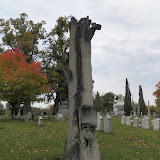
 I found the red-turned leaf on the ground in Forest Lawn, near the graves of my great-grandparents, having just watered the flowers in their urn. The first leaf of the fall. Yes, autumn will be here, again, before I am ready for it. And I am okay with that. Who could ever be ready for the harvest? 


Monday, August 5, 2013

Still here...


A quick note. I'm still here. How embarassing, to think, it has been months since I last wrote a post.

 Summer can be such an off time for the ghost, the early darker chilled nights of October no more than a ghostly memory when the world is warm and bright. 

 I've been spending the summer among the stones. Running, walking; in offices, researching, archiving. Finding the ghost where I can. Getting back into writing, slowly. I have taken so many photos, in graveyards, so many subjects, stories, people to write about, post here.

Yes, I will be here more.  

Sunday, March 31, 2013

Happy Easter, from the Ghost!

To all who celebrate- Happy Easter!

This is my lone craft offering for the day- made with Funkin brand foam eggs, which I found at Hobby Lobby. The credit for the pattern goes to Zombie Pumpkins (and is a combination of one of their Easter patterns and the template for the "Sleepy Hollow" jack o'lantern from the 1999 Tim Burton film I had bought two to create, but I quickly found carving foam Easter egg is much harder on the hand than cutting through pumpkin.

Sunday, February 24, 2013

M A Campbell, 1801 - 1803

    I took these photos in the cemetery back this October past. I'd been talking with my good friend Michael who has a fondness for owls and cemeteries, and it occured to me that I had never photographed something interesting in Forest Lawn. There is no shortage of interesting, singular, quiet and beautiful aspects to and monuments within the Lawn. This has left no shortage of photos left to be taken; and so I am always up for the opportunity to document and share new sights with all who may be reading here. With that thought in mind, I took my camera to M A Campbell's monument, thinking I would quickly write up a blog post. I find myself four months later finally coming across the pictures in my camera, and organizaing and uploading them.

    I first came to know M A Campbell's monument when on a tour one beating warm summer afternoon in Forest Lawn's air conditioned trolley, one of my favorite guides began discussing what I have always thought of as "tree stones." These gravestones made to look like old trees, from a mostly older time, spanning a wide period between the nineteenth and earlier twentieth centuries. My guide mentioned the art of these tree stones was popular and symbolic for a considerable amount of time-- and in many instances, the condition of the tree is related to the life a person lived. Cut or broken branches are a sign that the person in memorium died young, cut down in the prime of their life. Such a clear metaphor, one that never occured to me before I was told it. In doing some of my own digging and researching online, I haven't found much on the origin of where these stones might have come from. Some sources credit a society founded in 1890 with the start of this practice; however, I've personally seen many of these that  were made from as many as ninety to one-hundred years before 1890. My own thoughts figure the stones were a common practice, and this society co-opted them and made their own versions for their members, as can be seen here. 


   But I digress. M A Campbell's tree stands in something of a clearing in Forest Lawn. On the original 80 acres, not far from the Pratt Monument I have written about. The tree stands rather by itself, which seems unlike so many places in the older areas of the cemetery. I had walked and ran past it many times, and even took photos of it, but when my tour guide that summer day mentioned that one of the Lawn's tree stones had the detail of an owl looking out a hole in the tree, I took immediately to looking for the stone in question, and quickly found it. What I had loved about M A Campbell's gravestone before was the open book resting on the tree, with the words of a life written on the pages, open. It had never occured to me to look up, really up, and see the owl sitting in the top of the broken tree.


    The feel the owl brings to the stone fits rather beautifully into this spot in the cemetery. The first time I read M A Campbell's dates on the stone I was confused. At first glance, I took the person's name to be "Ma," a likely nickname for a grown woman, quite possibly a mother or grandmother. But a reading of the dates shows M A Campbell was a two year old child at the time of her or his death. A child who was born in 1801 and passed on in 1803. A child who had a family willing and able to construct this elaborate, artistic remembrance. I don't believe a two year old would have been called "Ma," but it is possible. Rather, I believe that M A are "M. A.": the child's initials. Standing for what first and middle names, I may never know. There is nothing I have found on the Internet or beyond. Only this monument, a tree, standing as testament to a life ended so soon after it began-- a life with immense potential and roots large as this tree; a life ended, this broken tree, which nature has reclaimed, with our owl standing guard in his residence above.

    The book of a life, the tree of a life, the natural end to one's life. Simple truth, standing alone in this silent clearing in Forest Lawn.

 You can see my whole album of M A Campbell in October, here: 
M A Campbell, Forest Lawn Cemetery, October 2012


All Photos Copyright Bryan Ball Photography, All Rights Reserved. 

Monday, February 18, 2013

"Sunnyside," Washington Irving's Home; Terrytown, NY

 Back in October, I made one last stop before leaving Sleepy Hollow. While the running around and taking the last few photos I wanted to was the last thing I officially did in the Village of Sleepy Hollow, before heading back home and across the state, I stopped at Washington Irving's home, "Sunnyside" in Terrytown.

 I wasn't sure what to expect. I hadn't seen a photo of the house or grounds before heading there. I only knew it lay further down the Hudson than anywhere else I'd been in Terrytown during the weekend. You park-- or at least on the Columbus Day weekend-- in a parking lot of what I believe were corporate offices of Kraft Foods, and take a shuttle bus a few miles down the road, and turn onto a narrower, winding road surrounded by trees and near woods, and a few very large houses. Very large houses.

 You come at the end to a parking lot next to what I can only describe as an antique looking-garden, and a small house. There is a declining hill and several buildings, and the sizable house that is Sunnyside at the base of the slope, right on the Hudson. For twenty dollars you can make it onto the grounds, and take a tour of the house.

 In Sleepy Hollow the day before, another tourist had mentioned that Sunnyside seemed to be more geared toward children-- but I still wanted to go, see what it was like, and walk the grounds that were home to the talent who wrote the legend of the Horseman.

 Sunnyside does have a lot to offer children and families. The sprawling grounds offer room for all sorts of activities, and the crew that manages Sunnyside takes full advantage that fact. There is story-telling (which I sadly missed), crafts, a playground, even outdoor cutouts you can stick your face through and have your photo taken as Ichabod, the Horseman or Rip Van Winkle. Which I may or may not have partaken in. There was scarecrow making for the children-- something that I would loved to have done, regradless of my age. But this activity was apparently only for the little ones. Sadly.

 Washington Irving's house is neither extremely large or small. The grounds, even with children running around shouting in the distance, are cool and calming, and as you walk to the front door alongside the Hudson River, you know this is an ideal place for a writer to be. Work, live. You understand. I took several photos outside the house, but none inside; they were not allowed. The tour is quick, taking you in small groups to Irving's library and workspace, dining room, hallways and kitchen. In each room is a person dressed as a member of the household staff, and they speak of how Sunnyside was a fully functioning home and estate, with the Irving family, a staff or servants and raised livestock.

 After the tour you leave the kitchen you come out into the courtyard-- where there is a rather ominous looking small structure: Irving's ice house. Designed by the writer himself to look like a "Gothic chapel" the ice house was a necessary function the household depended on to store ice in for the home, for refrigeration purposes. Without knowing the function of the ice house, the place is quite odd looking-- a small and unusual elegant shack of sorts, with large saws on the wall.

 After walking around Sunnyside for a while, I came to the refreshment stand next to the gift shop. Where I may have had pie and hot apple cider, the last official event of my Sleepy Hollow weekend.

 I hope to go back to Sleepy Hollow, someday. What I wasn't able to do as tickets were sold out the entire time I was there and well before, was see The Great Jack O'Lantern Blaze, an attraction the woman at the Sunnyside refreshment stands attested to the worthiness of. "Blaze" takes place at the Van Courtlant Manor, and consists of more than 5,000 individually carved jack o'lanterns put together in a variety of displays. I would like to see that. And I would like to go back to the cemetery in Sleepy Hollow, and explore. More, take photos. Of course. Yes, I think I will go back there someday.

You can see my complete Photo Album for my "Sunnyside" visit here:
Sunnyside, Washington Irving's Home; Tarrytown, NY


And you can read all the posts from my Sleepy Hollow Weekend 2012 here. 


 One last note to leave the writing of Sleepy Hollow on, for now. Here is a photo of myself I couldn't resist taking the first night, the first time I saw the Horseman's bridge, the Old Dutch Church and the cemetery.


All Photos Copyright Bryan Ball Photography, All Rights Reserved. 

Sunday, February 10, 2013

Leaving Sleepy Hollow


My last morning in Sleepy Hollow. Consisted of a few things. I had wanted to get proper photos of the Sleepy Hollow town sign, try and get as close as possible to the lighthouse, photograph another statue of Ichabod and the Horseman's ride I had seen the first night.

 It was cooler than the two days previous, but pleasant. Passing the cemetery again a last few times, I so badly wanted to go back in-- but knew there was no time.


 The lighthouse stands in the Hudson, looking neither very old nor new-- but seems perfectly suited for the waters off Terrytown and the Hollow. Because of confusion on my part and trying to find out more about the lighthouse online, I thought there might still be tours going on that Monday (though it was the Columbus Day holiday) but some more Internet digging showed the tours were done for the season. After some driving, asking a local person, and more driving, I was able to find a waterfront park that overlooked the lighthouse, almost directly. I didn't see the sign that you had to have a valid Westchester County resident's ID until I was on my way out, however.

 In the photos of the lighthouse, you can see the Tappan Zee bridge, some geese and New York City in the distance, miles away. The park was mostly deserted, dare I say ghostly-- and very relaxed. I could have taken photos there all day-- and, looking at how some of them turned out, I should have taken more-- but there was much more to be done before heading back home.

 I was able to stop by the village sign and snap some photos, and some of the local high school's sign (the school stands right behind the village sign). The high school who's team name, of course, is the Horsemen.

 I was able to find again the spot where this stone carving commemorating Irving's story was, by the front of the entrance to the "Horseman's Hollow" haunt. There is something small and serious about this carving-- and what struck me most about this was the decisive side the statue takes on the story. In the stone, which looks as if it would fit perfectly amongst the graves of the cemetery, the horseman chasing Ichabod has clearly covered his head with a sheet. One of the things I love most about the legend is that-- like all good ghost stories of its kind-- it leaves the reader, listener not knowing. Was Ichabod felled by the Horseman's specter-- or something more humanly sinister, at the hands of Brom Bones? I found it interesting that I finally really looked at this in the light of day. Here, it appears the sculptor believes the Horseman was not a ghost, but Brom Bones. But why, then, I always wonder, would Brom want to attack Ichabod-- after Ichabod had just lost Katrina to Brom? Did Katrina also reject Brom? Was Brom simply an insufferable bully? Or was the ghost real? For all its beauty, the story never tells you-- though this piece of art makes a guess.

 And so I left the Village of Sleepy Hollow, with one more stop to make it Terrytown before beginning the trip back across New York State, for home.

View my complete Photo Album here:
Leaving Sleepy Hollow


All Photos Copyright Bryan Ball Photography, All Rights Reserved. 

Wednesday, January 30, 2013

Susie Hayt Dibble, 1853- 1897

 In writing of my trip to Sleepy Hollow, NY last October, I had said I would come back for Susie Hayt Dibble.

 When you enter the Sleepy Hollow Cemetery, by the gate nearest to the Old Dutch Burial Ground, you walk along a main road, and path, that calmly takes you deeper into the cemetery, up into the hills near the river, and the forest. When you leave the Old Dutch Burial Ground, and begin to enter the Sleepy Hollow Cemetery proper, you find a series of mausoleums built into the scaling, hilly terrain, and trees. Not long after that you come to Susie Hayt Dibble's monument. 

 From all the cemetery exploration I have done, I have found that there are monuments that immediately interest you, and draw you in. Many of them go deeper than initial impressions, and reveal a quiet kept trove of detail and meaning, that let you feel as if you know a part of the person who left this remebrance, the art-- and life-- behind. Susie Hayt Dibble's monument is without question one of these. 

 The Dibble plot is partially enclosed by a low, somewhat rusting, open rectangle of metal, laying close to the ground. Within the plot are four stones and a staue. You see the statue first. When looking at the statue, it is easy think this stands as memory only to Susie Hayt. Her name is clearly marked on the base of the structure. However, a much smaller marker, for her husband George Dibble, lays immeditately in front of the monument. Susie Hayt Dibble is in a section of the cemetery with many other statues, mausoleums and memorials from another era, another time of great wealth. Susie's-- just down the path from the Lister monument-- is one of the simpler ones, yet far more striking. In the monument's statue, a woman clings to a cross in what appears to be the act-- or attempt-- of pulling herself up by way of the cross. The woman in the statue stands with her back to the drop of the hill and path below, down to the woods and the river, not far from the unofficial Horseman's bridge. On the day I first saw the grave, a wind and chill bothered the trees, and you easily could hear the stream below. 
 Every memory I have of that day-- with special attention to my time on the hill with Susie's grave-- is of me feverishly snapping the shutter and taking as many photos as I possibly could. And yet from the time I first looked at the photos back at my hotel room that night, I wished I had taken more; from more angles, differing perspectives. I wish I had done more that showed her place on the descending hill. And I wish I had done more strictly black and white photographs. 

 I hoped that afternoon the evening's tour would stop by her. But I tried not to hope too much. Considering the size of the cemetery alone, I knew there would be a world of worthy stops the tour couldn't possibly make. So I hoped, snapped some more photographs, and left to take in more of the cemetery. 

 The Dibble gravesite was one of the earlier stops on the tour that evening. I tried to take more photos of her in the dark, but nothing major turned out. I tried to take a photo of my lantern with the monument-- and it looked like it had turned out in my camera's preview box-- but I know not what came of it, as no such picture was on my camera afterward. 

 When our great guide stopped at Susie Hayt, I was eager to hear her history. The following is paraphrased. "This is one of my favorite stops," he said. "Susie Hayt Dibble." This was when the first of the raindrops started, stopped. "What is known of Susie Hayt Dibble? Not much, I'm afraid." He went on to give a history of how little is known of her or her kin, yet the statue is one of the more interesting within the cemetery grounds. "It's actually quite creepy," he said, walking up to her from the path and shining his light. "I'll let you each come up and take a look in a moment, but the woman here is missing her nose, and looks a bit like Voldermort from Harry Potter."

 As he let people in pairs walk up to the statue and take a look around her, he and a few in our group hypothesized what the statue might mean. Our Ichabod-ish guide suggested that either she-- or someone-- was trying to hold on to a faith, in spite of doubts or struggle because of death or other strife. This was when the woman who never directly professed to have psychic abilities in our group spoke up. "That's exactly what it is. Holding on to a faith that's falling away, falling away from you because of death, too." 

 My first Internet searches the night of the tour turned up nothing on the Dibbles but their pages on Find a Grave, where I realized for the first time that while the woman in the monument appeared to be the one struggling, Susie Hayt died in 1897, some twenty years before her husband. Leaving it likely that he-- perhpas not she, though one never knows-- was the one facing the struggle, the uphill climb. Or nothing so simple. 

 In processing the photos for my first Sleepy Hollow post, I searched a little further for the Dibbles-- and as was the case with the Lister monument and their New York Times article-- it is amazing what the swirling mass of voices the Internet is can provide if only you weed through some of the louder, unecessary shouts. On the website of a historic preservationist, I found listed some information about the George W. Dibble Family. The Dibble family owned an estate in Albany County named "Nearwood," in Knox, NY. The Dibbles are listed because of their estate's proximity to and eventual ownership of the historic Octagon House-- which the information on the site concerns. According to the write up on the website, George Dibble married Susie Hayt Parish in 1877; a year later their only child, a girl, was born. In the 1880 census, Mr. Dibble's occupation was listed as "no business," and in 1882, Susie Hayt Dibble purchased the historic Octagon House, and the family moved there. Susie died in 1897 from tuberculosis at Sarnac Lake. She was 43 years old when she died. George went on to marry Susie's younger sister, and move from the Octagon House. Mabel, George and Susie's daughter (who is buried underneath her own, smaller stone in the Dibble lot) did inherit ownership of the Octagon House. However, she died of heart failure at only 24, shortly after giving birth to her daughter.

What there is no mention of, however, is the Dibble's "Baby Boy," who has a marker to the left of the monument inside the lot, which is the same size as Mabel's. One of the saddest things I see, so often, in old cemeteries, is the monument which bears the name "Baby Boy" or "Baby Girl." It was often common-- especially during the time the Dibbles lived-- to not name a child until they had lived for a year or more, as the mortality rate for young children was so high. Although this was a prevalent custom, it seems that, for those who were able and could afford to, families made certain that these nameless children be remembered, with a mark in stone of their own.

 All of which is amazing; this information is able to be found and so easily-- and yet it will always leave so many questions. Who designed the monument? And why? Is the woman trying to pull herself up on the cross holding on to a faith falling from her-- is she falling from her faith? Her salvation? Nothing so simple or able to be known? Even when one knows some of the sad details of what may have been a happy-- though short-- life of a family, one can never know, not really, the answers to these questions. Perhaps, that is a large piece of the point. Whatever the reasons may be behind Susie Hayt Dibble's monument, it stands, on that hill alone in the Sleepy Hollow, as a testament to everything I love about cemeteries and their graves within: the quietly left behind stories; the remembrances, the possibilities and the questions.


All Photos Copyright Bryan Ball Photography, All Rights Reserved.