In writing of my trip to Sleepy Hollow, NY last October, I had said I would come back for Susie Hayt Dibble.
When you enter the Sleepy Hollow Cemetery, by the gate nearest to the Old Dutch Burial Ground, you walk along a main road, and path, that calmly takes you deeper into the cemetery, up into the hills near the river, and the forest. When you leave the Old Dutch Burial Ground, and begin to enter the Sleepy Hollow Cemetery proper, you find a series of mausoleums built into the scaling, hilly terrain, and trees. Not long after that you come to Susie Hayt Dibble's monument.
From all the cemetery exploration I have done, I have found that there are monuments that immediately interest you, and draw you in. Many of them go deeper than initial impressions, and reveal a quiet kept trove of detail and meaning, that let you feel as if you know a part of the person who left this remebrance, the art-- and life-- behind. Susie Hayt Dibble's monument is without question one of these.
The Dibble plot is partially enclosed by a low, somewhat rusting, open rectangle of metal, laying close to the ground. Within the plot are four stones and a staue. You see the statue first. When looking at the statue, it is easy think this stands as memory only to Susie Hayt. Her name is clearly marked on the base of the structure. However, a much smaller marker, for her husband George Dibble, lays immeditately in front of the monument. Susie Hayt Dibble is in a section of the cemetery with many other statues, mausoleums and memorials from another era, another time of great wealth. Susie's--
just down the path from the Lister monument-- is one of the simpler ones, yet far more striking. In the monument's statue, a woman clings to a cross in what appears to be the act-- or attempt-- of pulling herself up by way of the cross. The woman in the statue stands with her back to the drop of the hill and path below, down to the woods and the river, not far from the unofficial Horseman's bridge. On the day I first saw the grave, a wind and chill bothered the trees, and you easily could hear the stream below.

Every memory I have of that day-- with special attention to my time on the hill with Susie's grave-- is of me feverishly snapping the shutter and taking as many photos as I possibly could. And yet from the time I first looked at the photos back at my hotel room that night, I wished I had taken more; from more angles, differing perspectives. I wish I had done more that showed her place on the descending hill. And I wish I had done more strictly black and white photographs.
I hoped that afternoon the evening's tour would stop by her. But I tried not to hope too much. Considering the size of the cemetery alone, I knew there would be a world of worthy stops the tour couldn't possibly make. So I hoped, snapped some more photographs, and left to take in more of the cemetery.
The Dibble gravesite was one of the earlier stops on the tour that evening. I tried to take more photos of her in the dark, but nothing major turned out. I tried to take a photo of my lantern with the monument-- and it looked like it had turned out in my camera's preview box-- but I know not what came of it, as no such picture was on my camera afterward.

When our great guide stopped at Susie Hayt, I was eager to hear her history. The following is paraphrased. "This is one of my favorite stops," he said. "Susie Hayt Dibble." This was when the first of the raindrops started, stopped. "What is known of Susie Hayt Dibble? Not much, I'm afraid." He went on to give a history of how little is known of her or her kin, yet the statue is one of the more interesting within the cemetery grounds. "It's actually quite creepy," he said, walking up to her from the path and shining his light. "I'll let you each come up and take a look in a moment, but the woman here is missing her nose, and looks a bit like Voldermort from Harry Potter."
As he let people in pairs walk up to the statue and take a look around her, he and a few in our group hypothesized what the statue might mean. Our Ichabod-ish guide suggested that either she-- or someone-- was trying to hold on to a faith, in spite of doubts or struggle because of death or other strife. This was when the woman who never directly professed to have psychic abilities in our group spoke up. "That's exactly what it is. Holding on to a faith that's falling away, falling away from you because of death, too."
My first Internet searches the night of the tour turned up nothing on the Dibbles
but their pages on Find a Grave, where I realized for the first time that while the woman in the monument appeared to be the one struggling, Susie Hayt died in 1897, some twenty years before her husband. Leaving it likely that he-- perhpas not she, though one never knows-- was the one facing the struggle, the uphill climb. Or nothing so simple.

In processing the photos for my first Sleepy Hollow post, I searched a little further for the Dibbles-- and as was the case with the Lister monument and their New York Times article-- it is amazing what the swirling mass of voices the Internet is can provide if only you weed through some of the louder, unecessary shouts.
On the website of a historic preservationist, I found listed some information about the George W. Dibble Family. The Dibble family owned an estate in Albany County named "Nearwood," in Knox, NY. The Dibbles are listed because of their estate's proximity to and eventual ownership of the historic Octagon House-- which the information on the site concerns. According to the write up on the website, George Dibble married Susie Hayt Parish in 1877; a year later their only child, a girl, was born. In the 1880 census, Mr. Dibble's occupation was listed as "no business," and in 1882, Susie Hayt Dibble purchased the historic Octagon House, and the family moved there. Susie died in 1897 from tuberculosis at Sarnac Lake. She was 43 years old when she died. George went on to marry Susie's younger sister, and move from the Octagon House. Mabel, George and Susie's daughter (who is buried underneath her own, smaller stone in the Dibble lot) did inherit ownership of the Octagon House. However, she died of heart failure at only 24, shortly after giving birth to her daughter.

What there is no mention of, however, is the Dibble's "Baby Boy," who has a marker to the left of the monument inside the lot, which is the same size as Mabel's. One of the saddest things I see, so often, in old cemeteries, is the monument which bears the name "Baby Boy" or "Baby Girl." It was often common-- especially during the time the Dibbles lived-- to not name a child until they had lived for a year or more, as the mortality rate for young children was so high. Although this was a prevalent custom, it seems that, for those who were able and could afford to, families made certain that these nameless children be remembered, with a mark in stone of their own.

All of which is amazing; this information is able to be found and so easily-- and yet it will always leave so many questions. Who designed the monument? And why? Is the woman trying to pull herself up on the cross holding on to a faith falling from her-- is she falling from her faith? Her salvation? Nothing so simple or able to be known? Even when one knows some of the sad details of what may have been a happy-- though short-- life of a family, one can never know, not really, the answers to these questions. Perhaps, that is a large piece of the point. Whatever the reasons may be behind Susie Hayt Dibble's monument, it stands, on that hill alone in the Sleepy Hollow, as a testament to everything I love about cemeteries and their graves within: the quietly left behind stories; the remembrances, the possibilities and the questions.
All Photos Copyright Bryan Ball Photography, All Rights Reserved.


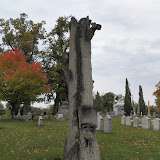
 The feel the owl brings to the stone fits rather beautifully into this spot in the cemetery. The first time I read M A Campbell's dates on the stone I was confused. At first glance, I took the person's name to be "Ma," a likely nickname for a grown woman, quite possibly a mother or grandmother. But a reading of the dates shows M A Campbell was a two year old child at the time of her or his death. A child who was born in 1801 and passed on in 1803. A child who had a family willing and able to construct this elaborate, artistic remembrance. I don't believe a two year old would have been called "Ma," but it is possible. Rather, I believe that M A are "M. A.": the child's initials. Standing for what first and middle names, I may never know. There is nothing I have found on the Internet or beyond. Only this monument, a tree, standing as testament to a life ended so soon after it began-- a life with immense potential and roots large as this tree; a life ended, this broken tree, which nature has reclaimed, with our owl standing guard in his residence above.