Showing posts with label Sleepy Hollow NY. Show all posts

Monday, February 18, 2013

"Sunnyside," Washington Irving's Home; Terrytown, NY

 Back in October, I made one last stop before leaving Sleepy Hollow. While the running around and taking the last few photos I wanted to was the last thing I officially did in the Village of Sleepy Hollow, before heading back home and across the state, I stopped at Washington Irving's home, "Sunnyside" in Terrytown.

 I wasn't sure what to expect. I hadn't seen a photo of the house or grounds before heading there. I only knew it lay further down the Hudson than anywhere else I'd been in Terrytown during the weekend. You park-- or at least on the Columbus Day weekend-- in a parking lot of what I believe were corporate offices of Kraft Foods, and take a shuttle bus a few miles down the road, and turn onto a narrower, winding road surrounded by trees and near woods, and a few very large houses. Very large houses.

 You come at the end to a parking lot next to what I can only describe as an antique looking-garden, and a small house. There is a declining hill and several buildings, and the sizable house that is Sunnyside at the base of the slope, right on the Hudson. For twenty dollars you can make it onto the grounds, and take a tour of the house.

 In Sleepy Hollow the day before, another tourist had mentioned that Sunnyside seemed to be more geared toward children-- but I still wanted to go, see what it was like, and walk the grounds that were home to the talent who wrote the legend of the Horseman.

 Sunnyside does have a lot to offer children and families. The sprawling grounds offer room for all sorts of activities, and the crew that manages Sunnyside takes full advantage that fact. There is story-telling (which I sadly missed), crafts, a playground, even outdoor cutouts you can stick your face through and have your photo taken as Ichabod, the Horseman or Rip Van Winkle. Which I may or may not have partaken in. There was scarecrow making for the children-- something that I would loved to have done, regradless of my age. But this activity was apparently only for the little ones. Sadly.

 Washington Irving's house is neither extremely large or small. The grounds, even with children running around shouting in the distance, are cool and calming, and as you walk to the front door alongside the Hudson River, you know this is an ideal place for a writer to be. Work, live. You understand. I took several photos outside the house, but none inside; they were not allowed. The tour is quick, taking you in small groups to Irving's library and workspace, dining room, hallways and kitchen. In each room is a person dressed as a member of the household staff, and they speak of how Sunnyside was a fully functioning home and estate, with the Irving family, a staff or servants and raised livestock.

 After the tour you leave the kitchen you come out into the courtyard-- where there is a rather ominous looking small structure: Irving's ice house. Designed by the writer himself to look like a "Gothic chapel" the ice house was a necessary function the household depended on to store ice in for the home, for refrigeration purposes. Without knowing the function of the ice house, the place is quite odd looking-- a small and unusual elegant shack of sorts, with large saws on the wall.

 After walking around Sunnyside for a while, I came to the refreshment stand next to the gift shop. Where I may have had pie and hot apple cider, the last official event of my Sleepy Hollow weekend.

 I hope to go back to Sleepy Hollow, someday. What I wasn't able to do as tickets were sold out the entire time I was there and well before, was see The Great Jack O'Lantern Blaze, an attraction the woman at the Sunnyside refreshment stands attested to the worthiness of. "Blaze" takes place at the Van Courtlant Manor, and consists of more than 5,000 individually carved jack o'lanterns put together in a variety of displays. I would like to see that. And I would like to go back to the cemetery in Sleepy Hollow, and explore. More, take photos. Of course. Yes, I think I will go back there someday.

You can see my complete Photo Album for my "Sunnyside" visit here:
Sunnyside, Washington Irving's Home; Tarrytown, NY


And you can read all the posts from my Sleepy Hollow Weekend 2012 here. 


 One last note to leave the writing of Sleepy Hollow on, for now. Here is a photo of myself I couldn't resist taking the first night, the first time I saw the Horseman's bridge, the Old Dutch Church and the cemetery.


All Photos Copyright Bryan Ball Photography, All Rights Reserved. 

Wednesday, January 30, 2013

Susie Hayt Dibble, 1853- 1897

 In writing of my trip to Sleepy Hollow, NY last October, I had said I would come back for Susie Hayt Dibble.

 When you enter the Sleepy Hollow Cemetery, by the gate nearest to the Old Dutch Burial Ground, you walk along a main road, and path, that calmly takes you deeper into the cemetery, up into the hills near the river, and the forest. When you leave the Old Dutch Burial Ground, and begin to enter the Sleepy Hollow Cemetery proper, you find a series of mausoleums built into the scaling, hilly terrain, and trees. Not long after that you come to Susie Hayt Dibble's monument. 

 From all the cemetery exploration I have done, I have found that there are monuments that immediately interest you, and draw you in. Many of them go deeper than initial impressions, and reveal a quiet kept trove of detail and meaning, that let you feel as if you know a part of the person who left this remebrance, the art-- and life-- behind. Susie Hayt Dibble's monument is without question one of these. 

 The Dibble plot is partially enclosed by a low, somewhat rusting, open rectangle of metal, laying close to the ground. Within the plot are four stones and a staue. You see the statue first. When looking at the statue, it is easy think this stands as memory only to Susie Hayt. Her name is clearly marked on the base of the structure. However, a much smaller marker, for her husband George Dibble, lays immeditately in front of the monument. Susie Hayt Dibble is in a section of the cemetery with many other statues, mausoleums and memorials from another era, another time of great wealth. Susie's-- just down the path from the Lister monument-- is one of the simpler ones, yet far more striking. In the monument's statue, a woman clings to a cross in what appears to be the act-- or attempt-- of pulling herself up by way of the cross. The woman in the statue stands with her back to the drop of the hill and path below, down to the woods and the river, not far from the unofficial Horseman's bridge. On the day I first saw the grave, a wind and chill bothered the trees, and you easily could hear the stream below. 
 Every memory I have of that day-- with special attention to my time on the hill with Susie's grave-- is of me feverishly snapping the shutter and taking as many photos as I possibly could. And yet from the time I first looked at the photos back at my hotel room that night, I wished I had taken more; from more angles, differing perspectives. I wish I had done more that showed her place on the descending hill. And I wish I had done more strictly black and white photographs. 

 I hoped that afternoon the evening's tour would stop by her. But I tried not to hope too much. Considering the size of the cemetery alone, I knew there would be a world of worthy stops the tour couldn't possibly make. So I hoped, snapped some more photographs, and left to take in more of the cemetery. 

 The Dibble gravesite was one of the earlier stops on the tour that evening. I tried to take more photos of her in the dark, but nothing major turned out. I tried to take a photo of my lantern with the monument-- and it looked like it had turned out in my camera's preview box-- but I know not what came of it, as no such picture was on my camera afterward. 

 When our great guide stopped at Susie Hayt, I was eager to hear her history. The following is paraphrased. "This is one of my favorite stops," he said. "Susie Hayt Dibble." This was when the first of the raindrops started, stopped. "What is known of Susie Hayt Dibble? Not much, I'm afraid." He went on to give a history of how little is known of her or her kin, yet the statue is one of the more interesting within the cemetery grounds. "It's actually quite creepy," he said, walking up to her from the path and shining his light. "I'll let you each come up and take a look in a moment, but the woman here is missing her nose, and looks a bit like Voldermort from Harry Potter."

 As he let people in pairs walk up to the statue and take a look around her, he and a few in our group hypothesized what the statue might mean. Our Ichabod-ish guide suggested that either she-- or someone-- was trying to hold on to a faith, in spite of doubts or struggle because of death or other strife. This was when the woman who never directly professed to have psychic abilities in our group spoke up. "That's exactly what it is. Holding on to a faith that's falling away, falling away from you because of death, too." 

 My first Internet searches the night of the tour turned up nothing on the Dibbles but their pages on Find a Grave, where I realized for the first time that while the woman in the monument appeared to be the one struggling, Susie Hayt died in 1897, some twenty years before her husband. Leaving it likely that he-- perhpas not she, though one never knows-- was the one facing the struggle, the uphill climb. Or nothing so simple. 

 In processing the photos for my first Sleepy Hollow post, I searched a little further for the Dibbles-- and as was the case with the Lister monument and their New York Times article-- it is amazing what the swirling mass of voices the Internet is can provide if only you weed through some of the louder, unecessary shouts. On the website of a historic preservationist, I found listed some information about the George W. Dibble Family. The Dibble family owned an estate in Albany County named "Nearwood," in Knox, NY. The Dibbles are listed because of their estate's proximity to and eventual ownership of the historic Octagon House-- which the information on the site concerns. According to the write up on the website, George Dibble married Susie Hayt Parish in 1877; a year later their only child, a girl, was born. In the 1880 census, Mr. Dibble's occupation was listed as "no business," and in 1882, Susie Hayt Dibble purchased the historic Octagon House, and the family moved there. Susie died in 1897 from tuberculosis at Sarnac Lake. She was 43 years old when she died. George went on to marry Susie's younger sister, and move from the Octagon House. Mabel, George and Susie's daughter (who is buried underneath her own, smaller stone in the Dibble lot) did inherit ownership of the Octagon House. However, she died of heart failure at only 24, shortly after giving birth to her daughter.

What there is no mention of, however, is the Dibble's "Baby Boy," who has a marker to the left of the monument inside the lot, which is the same size as Mabel's. One of the saddest things I see, so often, in old cemeteries, is the monument which bears the name "Baby Boy" or "Baby Girl." It was often common-- especially during the time the Dibbles lived-- to not name a child until they had lived for a year or more, as the mortality rate for young children was so high. Although this was a prevalent custom, it seems that, for those who were able and could afford to, families made certain that these nameless children be remembered, with a mark in stone of their own.

 All of which is amazing; this information is able to be found and so easily-- and yet it will always leave so many questions. Who designed the monument? And why? Is the woman trying to pull herself up on the cross holding on to a faith falling from her-- is she falling from her faith? Her salvation? Nothing so simple or able to be known? Even when one knows some of the sad details of what may have been a happy-- though short-- life of a family, one can never know, not really, the answers to these questions. Perhaps, that is a large piece of the point. Whatever the reasons may be behind Susie Hayt Dibble's monument, it stands, on that hill alone in the Sleepy Hollow, as a testament to everything I love about cemeteries and their graves within: the quietly left behind stories; the remembrances, the possibilities and the questions.


All Photos Copyright Bryan Ball Photography, All Rights Reserved. 

Tuesday, January 1, 2013

Sleepy Hollow Cemetery, October 2012


 At long last, I have organized all the photos from my Sleepy Hollow trip in October that I took during the afternoon, my first time exploring the cemetery. It would be no exaggeration to say I took hundreds more; at points, I was felt as if I needed to take photos faster than my shutter could manage. The photo album as it stands now is a mere 222 photos. For the record, I've left in some shots I normally would delete, if they were of some interest or no clearer picture existed for.

In recounting my Sleepy Hollow trip, I last left off here-- at the gates of the Sleepy Hollow Cemetery, after exploring the village on a sleepy, chilly October afternoon. Set up at the cemetery gates were tables for the cemetery to sell their wares to support their historic effort. (Among which truly were the best souvenirs to be found in town.) I bought the cemetery's main book, "The Old Dutch Church of Sleepy Hollow: Legends and Lore," and several other mementos, some of which bore the inscription "I lost my head in Sleepy Hollow."

The Dutch Burial Grounds
 The Sleepy Hollow Cemetery exists in two parts. The immediate grounds around the Old Dutch Church which Ichabod raced for is known as the Old Dutch Burial Ground; for it is the original, old Dutch burying ground. Immdiately adjacent to the Old Dutch stones is the greater Sleepy Hollow Cemetery. There are no fences or signs distinguishing the two-- and as I walked, map in hand, I had no idea how big the historic cemetery actually is. The grounds were impossible to cover in a day-- the hills, the trees, the forest, the bridge-- and try as I wanted to I could not see, take in nor photograph all the tombstone beauty I saw.

Lister Monument
 It's striking how vastly diffnerent the kinds of people who are laid to rest in Sleepy Hollow are. The Old Dutch Burial Ground houses some of the earlier settlers( and even a rumored witch.) Washington Irving himself, who wished the grounds to be renamed "The Sleepy Hollow Cemetery" during his life (a request honored some years after his death) is laid to rest there. As are a number of the earlier portions of the twentieth century's wealthiest players (Andrew Carnegie, Elizabeth Arden and father of the labor movement Samuel Gompers, among them.)


Susie Hayt Dibble monument
The timespan of the cemetery and the variety of nature, life and history that lives within the Sleepy Hollow Cemetery bears much similarity to my home cemetery of Forest Lawn's. The generations of people and their monuments that are left behind in such a rolling, secluded natural setting is at once like Forest Lawn, and distinctly different. In all my exploring of cemeteries, I had never, in person, seen the kinds of older, intricate stones that lie within the Dutch burial ground. And to see so many, up close and for my camera (as much as I wanted, I dared not touch them) was something special.

If you made me pick a favorite, or most interesting monument inside the Sleepy Hollow Cemetery, I would easily pick Susie Hayt Dibble. I left Sleepy Hollow with a few photos of her monument, and some thoughts, which I believe I will post about separately this week when I have finished both this post and the next about the nighttime lantern tour that followed.

The traditional 'Horseman's Bridge' deep in the cemetery
 That afternoon in the cemetery, there were two things working against me and my quest of taking as many photos as humanly possible while I saw all the sights there were to see. One, was the daylight as it dwindled. I had tickets for a nighttime lantern tour that evening, but I wanted to see everything I could before the tour; and then have it explained to me. The second was power. I had charged the batteries in my camera all the night before in my hotel room. Normally, if I spend even a couple hours to a whole afternoon roaming Forest Lawn and taking pictures, my batteries always last. They may be slightly depeleted after a few hours, but would be able to keeep going. In the Sleepy Hollow Cemetery, my fully charged batteries for the day lasted about twenty minutes before I had to run over to a gas station to get replacements that would work in my camera. Those lasted a little over an hour. The next batteries, from a different store, lasted a little less than that-- and my memory card, which I had thought would be able to take the afternoon, failed me, as well. Whether they were the victimn of the supposed draining that can occur around paranomally charged places, or the fault of poorly made or old batteries, I will never know. 

Toward the end, I had to furiously delete photos off my camera that I thought were less worth saving than any others. I did so until my batteries gave out. Once that happened, I took several pictures on my iPhone, before relenting to the chill which had now become cold and left to find more batteries, a new memory card and dinner in Tarrytown before the nighttime tour began at nine.

You can see my full Photo Album of the afternoon here: 

Exploring the Sleepy Hollow Cemetery, Sunday afternoon


Monday, October 29, 2012

Exploring Sleepy Hollow, Sunday afternoon

  My first morning in the Sleepy Hollow area began by searching for somewhere to go for a run. Staying across the Hudson, just on the other side of the Tappan Zee Bridge, I found myself at a hotel in a section of Nyack, New York, that was conveniently located exactly at a thruway exit,  but in an area void of any proper sidewalks. I ran up one street, and the sidewalk ended. I ran along another, and in passing wished there were a cemetery somewhere nearby where I could run, as I do in Forest Lawn when I am at home. I ran not twenty seconds down another block, turned a bend-- and an enormous cemetery, set on a large hill, appeared before me. The gates were open, and I would find that the sprawling graveyard spanning the hill was more than large enough to run in, and had graves going back to the very early 1880's, at least. There was even an old plot for a family by the name of "Crane." At the very top of the cemetery, having ran up the hill, you can see over the Hudson River, to Tarrytown and Sleepy Hollow. 


 I was excited to head back over the bridge, pass through Tarrytown, and be in Sleepy Hollow, again. The plan was to wander around the village, see any sights there may be to see, and head to the cemetery. The night before, from what I could see of the cemetery from the Old Dutch Church, I thought I knew how big-- or, rather, small-- it actually was. The lantern tour was not until seven in the evening; I thought that after looking around the village, I could see what the full cemetery was like, and take it all in prior to the tour. 

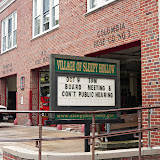
 My first thoughts seeing the Hollow in daylight were, still, that the Horseman was everywhere. From the street signs, to the village hall-- to restaurants, the post office and fire department-- either he was there on horseback, or he was chasing poor, terrified Ichabod. It was also quietly amazing, pleasantly surprising how much the village, in 2012, feels like the opening lines of Irving's story. In my head, walking the streets, I heard the words "Not far from this village, perhaps about two miles, there is a little valley, or rather lap of land, among high hills, which is one of the quietest places in the whole world. A small brook glides through it, with just murmur enough to lull one to repose; and the occasional whistle of a quail, or tapping of a woodpecker, is almost the only sound that ever breaks in upon the uniform tranquillity."

The weather was calm. Even the wind was quiet-- and the dropping rain, sparing but ever present. The leaves continued to drift down from the trees, falling to pave the streets. There are several streets intersecting with the main road in the village, and the shops, stores, homes, restaurants and the like did not seem big, did not seem small-- just quiet. Very sleepy. "A drowsy, dreamy influence seems to hang over the land, and to pervade the very atmosphere." I could hear Irving's words very clearly. 

As I headed closer to the bridge, the church and the churchyard, I began to completely understand the influence a place like this can have, the spirit which makes tales such as the Horseman possible. "A drowsy, dreamy influence seems to hang over the land, and to pervade the very atmosphere. Some say that the place was bewitched by a high German doctor, during the early days of the settlement; others, that an old Indian chief, the prophet or wizard of his tribe, held his pow-wows there before the country was discovered by Master Hendrick Hudson." 


 In the daylight, it struck me how clear you can see Ichabod's path. Walking up the street, you see the bridge, the church and churchyard all in succession-- and, now, you even see a statue of the Horseman's chase, as if Ichabod will eternally be riding that way, for the bridge he will never reach. I imagine Washington Irving wouldn't be able to help being proud, if he were able to come back (from the churchyard) to the Hollow today-- and see that the legend he penned to paper has taken on such an immortal life, it nows stands literally in the spot which the fiction took place. It is an awesome thing, an aweseome feeling. 

 Finally, I came to the church again. The plan was to explore the cemetery on my own, in the daylight, in preparation for the tour. Before passing through the gates, I  met the tent sent up by the Old Dutch Church to sell souveniors and the like. Incredibly charming people, with wares that many of which were nicer and more interesting the the gift shop by the Horseman's Hollow I'd been to the night before. I bought their book on the cemetery, among other things-- and headed off to walk among Sleepy Hollow's graves. 
The street, the bridge, the church and churchyard- with the statue far right.


My full album of the afternoon (before the cemetery) here:

Thursday, October 18, 2012

My first Night in Sleepy Hollow, New York

A lantern, lighting the way to the Old Dutch Church

After the drive full of the changing and falling leaves, I finally got to Sleepy Hollow. I came into the village for the first time at night, well after dark. Crossing the Hudson from Nyack, I can't say for sure what I thought Sleepy Hollow might look, feel like.

 You come into Sleepy Hollow crossing the Tappan Zee Bridge. The long, wide, winding bridge spans the Hudson River and, at night-- at least on the first night I crossed the bridge-- you can look over your shoulder to the south, and see the lights and skyline of New York City. You finish the bridge, pass the tolls, and take a turn-- and you are in Tarrytown and, suddenly, the Village of Sleepy Hollow.

 In the opening of Washington Irving's "The Legend of Sleepy Hollow," Irving describes the area known as Sleepy Hollow, and admits that the area is "properly known by the name of Tarry Town." The actual Village of Sleepy Hollow as it stands now is officially known as such, having changed the name to "Sleepy Hollow" in 1997 (which, my cemetery tour guide would later say, did wonders for their tourism industry.) The Village of Terrytown still exists, home to Washington Irving's home and the delicious Tarrytown Tavern-- but more on those places, later.
The Old Dutch Church

 Driving into the villages of Tarrytown and Sleepy Hollow feels small. You are suddenly driving along a winding, hilly, tight street lined with a small and-- absolutely-- sleepy village. In Tarrytown, you begin to see the images of the Horseman. On flags adorning people's homes, on shops and in restaurant windows. And then the sign for the Village of Sleepy Hollow appears, and the Horseman is everywhere. On the town hall, on police and fire vehicles-- and then you are at the center of Sleepy Hollow. All the while you have been driving along the hilly terrain you have been driving down-- and just as you hit the bridge by the church the road begins to climb up.

The altar, with Ichabod jack o'lantern atop.
 The bridge by the church is the bridge by the church. The Horseman's. Washington Irving settled in the area he loved after being sent there during his youth from New York City to avoid the yellow fever outbreak in the late 1700's. There is something so uniquely special, moving, about seeing the inspiration of a story you have loved all your life, and held so dear. Seeing that, yes, the story is real. "The Legend of Sleepy Hollow" has long dominated my literary understanding, and my love for the Halloween season. Since childhood, the animated Disney version of the tale has been the standard all other ghost stories are held to. There is so much in the story, about the telling of tales, of ghost stories, about what is and can be truth with the supernatural-- that is so classic, so autumn, so ripe of the harvest, so Halloween. Walking up to the bridge, and seeing what brought Irving to write the story-- still there-- was amazing. No, the bridge is not wooden and covered and in the woods, but the bridge is there. Paved over and modern, there is still a river it stands over-- and you cross the bridge, look up and see the Old Dutch Church; which, too, remains.

Ichabod

 I had tickets to the last performance of "Irving's Legend" for the evening, which takes place in the Old Dutch Church. "Irving's Legend" is a performance piece by professional storyteller Jonathan Kruk, who offers a one man (and an organ player) performance of "The Legend of Sleepy Hollow." I tell you, the grinning smile spanning from my one ear to the other did not leave my face the whole night. I was in Sleepy Hollow. Having crossed the horseman's bridge. In the Old Dutch Church. Outside each window, you can see the cemetery which surrounds the church. And you are surrounded by candle lit jack o'lanterns. With the organ blaring. And then the tale of the horseman begins to be told from the altar. Jonathan Kruk gives a great performance of the tale-- and it's certainly worth noting he gives these performances multiple times a night, most nights. Being told live, as he does, you truly get to experience such an essential part of Irving's tale-- how the Horseman is all about the legend, the telling of ghost stories together, and sending you out home, alone. Into the darkness.

The Horseman's Bridge.

 After Kruk's performance, I walked around the church taking photos, still on a cloud of Halloween. Later, taking some outside of the church, I quickly realized my limitations with my camera at night-- taking photos in the dark is something I don't have much experience in, and playing with the flash and seeing what it can and cannot do made me wish I had practiced some more before the trip. But I don't think all of these photos are bad, and I loved taking them. It was so hard to be torn away from the old church, the cemetery, the bridge and the rest of the hollow, in the dark. Across the street, and down a riverbank, is the Horseman's Hollow haunted house attraction, but even that was dark, quiet and sleepy. Occasionally, on a light wind, the screams of those going through would drift over. And there was nowhere else I would rather have been.

In vain, I tried taking some pictures of one of the Horseman and Ichabod statues in the dark, before acquiescing to go back to the hotel-- and return with the daylight on Sunday to spend the day exploring the village and, at long last, the cemetery.

 You may view my photo album from my first night in Sleephy Hollow here:

Old Dutch Church, First Night in Sleepy Hollow


 And a short video I took sitting in my pew, waiting for "Irving's Legend" to start in the Old Dutch Church: 


Thursday, October 11, 2012

Fallen, slowly

 I know this isn't the Sleepy Hollow update I was looking forward to. When I finally sat down, after returning home from Sleepy Hollow, New York, to organize all the photos I had taken on my memory cards (both the one I took, and the new one I had to buy at a Walgreens when my original card filled up)-- I realized I had quite a few photos.

 And so I am uploading them in the order they were taken, and will update in sections. This first set is simple, from a rest area somewhere in the Catskills region of southern NY. There were signs posted that the woods were private property, and they kept me from going into them too deep. But the quiet, trickling creek and the leaves still, so slowly, falling, were too autumn, too breathtaking and too gorgeous for my camera to resist.


 The leaves aren't Sleepy Hollow, but they were the perfect introduction to my long weekend in the Hudson Valley. Driving across the most southern part of my state, I saw the trees exploding in reds and oranges and yellows and deep greens we have not even begun to see here yet. It was as if fall were exploding louder driving across the state, culminating in the small, iconic hollow on the Hudson River.

 You may view my photo album here:

Catskill Region Rest Stop

Thursday, October 4, 2012

First pumpkin, off to Sleepy Hollow


 A brief post. This weekend, I will be off in Sleepy Hollow, NY, for the first time in my life. I could not be looking forward to getting there more, and I do plan on blogging as much as I can while I am there. If, for some very possible reason, I don't get to blog while there, I know I will have a photo or two to blog about when I get home.

 This here pumpkin is the first I've bought this season. None of the pie pumpkins or jack o'lanterns I tried growing in the yard made it, and so I have broken down and begun buying pumpkins which seem to be good carving candidates. I have a few ideas what this may become.

For the last few years, I've done some major carving projects, but only one or two a year, and always on Beggar's Night and Halloween itself. My goal this year is to start carving them earlier-- but not too early-- this year. Perhaps next weekend?