Showing posts with label Autumn cemeteries. Show all posts

Wednesday, October 4, 2023

Sometimes, I like to go for walks in graveyards


 And run there. And take photographs. And, sometimes, I just read under a tree. I have a favorite tree. 


 This afternoon I went to read there, but ended up taking my camera (and phone) and taking countless photos, too. The ones here are all from my phone.


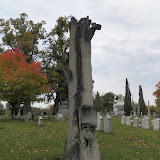
 This area of the cemetery is one of my favorites. One of the oldest areas on the oldest grounds, which was also used as a cemetery before the cemetery was officially incorporated. Here, in the fading afternoon light, the world, and even October, stands still. Every now and then a leaf will fall to the ground. If you’re listening, you can just hear it.   


Sunday, November 12, 2017

Rising From the Grave


     It's been a quite crypt here at Ghost Upon the Floor this year. To our readers, we apologize for the silent graveyard. For many haunted, Halloween hearts, November brings the start of a new year, and in this new year, things will be more active among our tombstones and posts here.

     The falling November leaves, rustling. A setting sun, marble grave stones tilted but standing strong. A mausoleum door creaks, slowly, the dark twilight descending. In the next year, the Ghost and Witch will walk forth from our graves upon the floor.


Friday, October 16, 2015

From the Pumpkin Patch


     Autumn brings many things. The colors of the world explode into vibrant beauty, the nights chill, dim, and the world swells with feasts of beauty—bright pumpkins and corn and apples and cider and spice and pies.

     This year’s harvest brought something new for What a Witch. The harvest’s beauty brought a little baby pumpkin. The new addition has us looking at our favorite season from a different perspective—one we have not looked from in some time. One of innocence.

     For What a Witch, gone are the days of blood, guts, and gore. Now the Halloween holiday is filled with cute pumpkins, sweet treats and pajamas with dinosaur feet, and chubby cartoon ghosts. What goes bump in the night, and haunts All Hallow’s Eve, is taking on a more family-friendly air.

     We’ve had the joy of introducing some of the autumn season’s magical things to our little pumpkin. A walk through the cemetery on a sunny day, the smell of mums in the peak or their blossom (did  you know mums have smell?); the sound of rustling leaves. The morning we took our walk, child and stroller in tow, was bright and warm. Fall was just beginning to peak out at us—in the flowering mums planted in 100 year old urns, in the deep red just beginning to seep into the trees. There was something so peaceful and sacred in walking around with the little one, passing beneath trees, seeing the lakes and the spiders spinning their webs. Reading names from stones, remembering if only for a moment the people who have come to rest in the cemetery, walking silently through the Chapel deep within the cemetery.

     The next week we took the little pumpkin to meet the great pumpkin, to a local pumpkin patch. On a Sunday morning in the later fall, at a farm in the country where goats ran free and horses watched from the barn, we took a horse-drawn wagon ride over the farm and to the pumpkin patch; a gray but nevertheless beautiful fall day. Pumpkins lay scattered on the ground, their vines twisting from the earth, and here and there were pumpkin guts and seeds from those gourds which fared less fortunately.


     We look forward to the years to come where we can watch the joy of the season grow, and last, through a child’s eyes.


Sunday, February 24, 2013

M A Campbell, 1801 - 1803

    I took these photos in the cemetery back this October past. I'd been talking with my good friend Michael who has a fondness for owls and cemeteries, and it occured to me that I had never photographed something interesting in Forest Lawn. There is no shortage of interesting, singular, quiet and beautiful aspects to and monuments within the Lawn. This has left no shortage of photos left to be taken; and so I am always up for the opportunity to document and share new sights with all who may be reading here. With that thought in mind, I took my camera to M A Campbell's monument, thinking I would quickly write up a blog post. I find myself four months later finally coming across the pictures in my camera, and organizaing and uploading them.

    I first came to know M A Campbell's monument when on a tour one beating warm summer afternoon in Forest Lawn's air conditioned trolley, one of my favorite guides began discussing what I have always thought of as "tree stones." These gravestones made to look like old trees, from a mostly older time, spanning a wide period between the nineteenth and earlier twentieth centuries. My guide mentioned the art of these tree stones was popular and symbolic for a considerable amount of time-- and in many instances, the condition of the tree is related to the life a person lived. Cut or broken branches are a sign that the person in memorium died young, cut down in the prime of their life. Such a clear metaphor, one that never occured to me before I was told it. In doing some of my own digging and researching online, I haven't found much on the origin of where these stones might have come from. Some sources credit a society founded in 1890 with the start of this practice; however, I've personally seen many of these that  were made from as many as ninety to one-hundred years before 1890. My own thoughts figure the stones were a common practice, and this society co-opted them and made their own versions for their members, as can be seen here. 


   But I digress. M A Campbell's tree stands in something of a clearing in Forest Lawn. On the original 80 acres, not far from the Pratt Monument I have written about. The tree stands rather by itself, which seems unlike so many places in the older areas of the cemetery. I had walked and ran past it many times, and even took photos of it, but when my tour guide that summer day mentioned that one of the Lawn's tree stones had the detail of an owl looking out a hole in the tree, I took immediately to looking for the stone in question, and quickly found it. What I had loved about M A Campbell's gravestone before was the open book resting on the tree, with the words of a life written on the pages, open. It had never occured to me to look up, really up, and see the owl sitting in the top of the broken tree.


    The feel the owl brings to the stone fits rather beautifully into this spot in the cemetery. The first time I read M A Campbell's dates on the stone I was confused. At first glance, I took the person's name to be "Ma," a likely nickname for a grown woman, quite possibly a mother or grandmother. But a reading of the dates shows M A Campbell was a two year old child at the time of her or his death. A child who was born in 1801 and passed on in 1803. A child who had a family willing and able to construct this elaborate, artistic remembrance. I don't believe a two year old would have been called "Ma," but it is possible. Rather, I believe that M A are "M. A.": the child's initials. Standing for what first and middle names, I may never know. There is nothing I have found on the Internet or beyond. Only this monument, a tree, standing as testament to a life ended so soon after it began-- a life with immense potential and roots large as this tree; a life ended, this broken tree, which nature has reclaimed, with our owl standing guard in his residence above.

    The book of a life, the tree of a life, the natural end to one's life. Simple truth, standing alone in this silent clearing in Forest Lawn.

 You can see my whole album of M A Campbell in October, here: 
M A Campbell, Forest Lawn Cemetery, October 2012


All Photos Copyright Bryan Ball Photography, All Rights Reserved. 

Wednesday, January 30, 2013

Susie Hayt Dibble, 1853- 1897

 In writing of my trip to Sleepy Hollow, NY last October, I had said I would come back for Susie Hayt Dibble.

 When you enter the Sleepy Hollow Cemetery, by the gate nearest to the Old Dutch Burial Ground, you walk along a main road, and path, that calmly takes you deeper into the cemetery, up into the hills near the river, and the forest. When you leave the Old Dutch Burial Ground, and begin to enter the Sleepy Hollow Cemetery proper, you find a series of mausoleums built into the scaling, hilly terrain, and trees. Not long after that you come to Susie Hayt Dibble's monument. 

 From all the cemetery exploration I have done, I have found that there are monuments that immediately interest you, and draw you in. Many of them go deeper than initial impressions, and reveal a quiet kept trove of detail and meaning, that let you feel as if you know a part of the person who left this remebrance, the art-- and life-- behind. Susie Hayt Dibble's monument is without question one of these. 

 The Dibble plot is partially enclosed by a low, somewhat rusting, open rectangle of metal, laying close to the ground. Within the plot are four stones and a staue. You see the statue first. When looking at the statue, it is easy think this stands as memory only to Susie Hayt. Her name is clearly marked on the base of the structure. However, a much smaller marker, for her husband George Dibble, lays immeditately in front of the monument. Susie Hayt Dibble is in a section of the cemetery with many other statues, mausoleums and memorials from another era, another time of great wealth. Susie's-- just down the path from the Lister monument-- is one of the simpler ones, yet far more striking. In the monument's statue, a woman clings to a cross in what appears to be the act-- or attempt-- of pulling herself up by way of the cross. The woman in the statue stands with her back to the drop of the hill and path below, down to the woods and the river, not far from the unofficial Horseman's bridge. On the day I first saw the grave, a wind and chill bothered the trees, and you easily could hear the stream below. 
 Every memory I have of that day-- with special attention to my time on the hill with Susie's grave-- is of me feverishly snapping the shutter and taking as many photos as I possibly could. And yet from the time I first looked at the photos back at my hotel room that night, I wished I had taken more; from more angles, differing perspectives. I wish I had done more that showed her place on the descending hill. And I wish I had done more strictly black and white photographs. 

 I hoped that afternoon the evening's tour would stop by her. But I tried not to hope too much. Considering the size of the cemetery alone, I knew there would be a world of worthy stops the tour couldn't possibly make. So I hoped, snapped some more photographs, and left to take in more of the cemetery. 

 The Dibble gravesite was one of the earlier stops on the tour that evening. I tried to take more photos of her in the dark, but nothing major turned out. I tried to take a photo of my lantern with the monument-- and it looked like it had turned out in my camera's preview box-- but I know not what came of it, as no such picture was on my camera afterward. 

 When our great guide stopped at Susie Hayt, I was eager to hear her history. The following is paraphrased. "This is one of my favorite stops," he said. "Susie Hayt Dibble." This was when the first of the raindrops started, stopped. "What is known of Susie Hayt Dibble? Not much, I'm afraid." He went on to give a history of how little is known of her or her kin, yet the statue is one of the more interesting within the cemetery grounds. "It's actually quite creepy," he said, walking up to her from the path and shining his light. "I'll let you each come up and take a look in a moment, but the woman here is missing her nose, and looks a bit like Voldermort from Harry Potter."

 As he let people in pairs walk up to the statue and take a look around her, he and a few in our group hypothesized what the statue might mean. Our Ichabod-ish guide suggested that either she-- or someone-- was trying to hold on to a faith, in spite of doubts or struggle because of death or other strife. This was when the woman who never directly professed to have psychic abilities in our group spoke up. "That's exactly what it is. Holding on to a faith that's falling away, falling away from you because of death, too." 

 My first Internet searches the night of the tour turned up nothing on the Dibbles but their pages on Find a Grave, where I realized for the first time that while the woman in the monument appeared to be the one struggling, Susie Hayt died in 1897, some twenty years before her husband. Leaving it likely that he-- perhpas not she, though one never knows-- was the one facing the struggle, the uphill climb. Or nothing so simple. 

 In processing the photos for my first Sleepy Hollow post, I searched a little further for the Dibbles-- and as was the case with the Lister monument and their New York Times article-- it is amazing what the swirling mass of voices the Internet is can provide if only you weed through some of the louder, unecessary shouts. On the website of a historic preservationist, I found listed some information about the George W. Dibble Family. The Dibble family owned an estate in Albany County named "Nearwood," in Knox, NY. The Dibbles are listed because of their estate's proximity to and eventual ownership of the historic Octagon House-- which the information on the site concerns. According to the write up on the website, George Dibble married Susie Hayt Parish in 1877; a year later their only child, a girl, was born. In the 1880 census, Mr. Dibble's occupation was listed as "no business," and in 1882, Susie Hayt Dibble purchased the historic Octagon House, and the family moved there. Susie died in 1897 from tuberculosis at Sarnac Lake. She was 43 years old when she died. George went on to marry Susie's younger sister, and move from the Octagon House. Mabel, George and Susie's daughter (who is buried underneath her own, smaller stone in the Dibble lot) did inherit ownership of the Octagon House. However, she died of heart failure at only 24, shortly after giving birth to her daughter.

What there is no mention of, however, is the Dibble's "Baby Boy," who has a marker to the left of the monument inside the lot, which is the same size as Mabel's. One of the saddest things I see, so often, in old cemeteries, is the monument which bears the name "Baby Boy" or "Baby Girl." It was often common-- especially during the time the Dibbles lived-- to not name a child until they had lived for a year or more, as the mortality rate for young children was so high. Although this was a prevalent custom, it seems that, for those who were able and could afford to, families made certain that these nameless children be remembered, with a mark in stone of their own.

 All of which is amazing; this information is able to be found and so easily-- and yet it will always leave so many questions. Who designed the monument? And why? Is the woman trying to pull herself up on the cross holding on to a faith falling from her-- is she falling from her faith? Her salvation? Nothing so simple or able to be known? Even when one knows some of the sad details of what may have been a happy-- though short-- life of a family, one can never know, not really, the answers to these questions. Perhaps, that is a large piece of the point. Whatever the reasons may be behind Susie Hayt Dibble's monument, it stands, on that hill alone in the Sleepy Hollow, as a testament to everything I love about cemeteries and their graves within: the quietly left behind stories; the remembrances, the possibilities and the questions.


All Photos Copyright Bryan Ball Photography, All Rights Reserved. 

Sunday, January 13, 2013

Sleepy Hollow Cemetery, Nighttime Lantern Tour, October 2012

Sleepy Hollow Cemetery, past the Horseman's bridge. Through the gates. Twilight sets in. A slight breeze comes on the dark, lush trees. The smell of rain on the air. Early October chill. A sprawling historical cemetery, laying over trees and hills and river-- just explored, to be explored.

 Children on Christmas morning don't have this much fun. I made sure I had enough batteries to last even repeated changes, and that I was carrying only my camera and my phone. From the time I bought my ticket, until I walked up to the group gathered for the tour, I wondered how the lanterns would work. Would each of us get a lantern? Would every few people get one to carry? The tours were sold out for the weekend, and almost throughout the rest of the month, so I wasn't expecting a small, quiet group.

 There were enough lanterns to use one for every two people. I had the lantern I would carry as mine on the tour, gray and warm.

 In the album, I made a decision not to delete any photos. If I had a hard time taking everything in during the afternoon, walking the cemetery at night amped the urgency to snap my lens up endlessly. As a result, I'm left with out of focus, blurred, rainy, over exposed and poorly set up snap shots-- but I don't think they are all so bad. I realize my limitations in changing light-- but I felt I learned a lot on my feet walking the tour. As the night progressed, and the rain began to drizzle and the cold set on, I'm very happy that I was still able to take some of the shots I did. And the light and condensation set up some interesting, misty effects, which I do appreciate.

 One of my highest hopes for the tour was that our guide be good. My preconceptions at first got the better of me, and when I saw that our guide was younger, I briefly wished that maybe someone--- older, perhaps--with more knowledge, was going to be the one doing the talking. But our guide-- a school teacher, not unreminiscent of Ichabod Crane himself-- proved me swiftly wrong with his wide breaths of knowledge, ability and willingness-- to keep on talking, expanding and answering questions.


 Our tour, starting just as dark had set in, first took us to the gravesites of Francis Pharcelleus Chruch (the author of the famous editorial to a young girl "Yes, Virginia, there is a Santa Claus", and a mausoleum of an early 1900s couple with a tortured history. Oh, and we were also taken to the place where 80's band The Raomones filmed their video for "Pet Sematary" (from the soundtrack of the film version from the Stephen King's novel "Pet Cemetery").


When we came to Susie Hayt Dibble's monument, it began to rain, lightlty. I'll write about what our guide said of her in the post to come. But this was the moment that a woman in our group began to speak up-- not at the guide but loud enough to be heard-- about Susie Hayt, as if she knew her. She continued to talk as we walked the few paces down the road to the Lister monument which I wrote about in my previous post. Sadly, I don't have any nighttime photos of the Lister monument, because the batteries on my camera had just passed on to the next world, and I was quickly working to put fresh ones in, while listening to everything our guide was saying.


At the Lister monument, our guide was recounting what was known of the family. Edwin Lister, apparently, treated his widow quite badly in the will he left behind. She was left a small portion of his wealth, and his children were the benefactors of what remained. Because of this, our guide mentioned (while stressing the following is wholly conjecture) that many wonder if the woman in the Lister monument is his widow, clutching the will in misery. The woman in stone does appear to be in no state of grief, but rather shock or anger, even. Perhaps she or someone with a particular knowledge and agenda regarding the situation had some part in the creation of the monument, our guide supposed. Following the tour, when I tried reasearching the Lister family, an article in The New York Times from June 13, 1898 regarding the details of Edwin's will is easily accesible. The story of the will is true. "It gives to his widow $50,000, to be paid to her in cash when she vacates the Lister homestead, and the income from an additional $50,000 as long as she lives." Again, the woman, who had spoken up at the Hayt gravesite, spoke up. Paraphrasing from my memory, she said "Yes. That's exactly right. But she was hurt so much by what he did to her."

 For the rest of the tour, the woman was mostly silent, only occasionally commenting on a gravesite's energy. I do not know what types of abilities this woman may or may not have had, but I do know that while the tour couldn't possibility have been any more wonderful, it would have been far less interesting without her commentary.

 Something I may not have mentioned in my previous post is that I never found Washington Irving's grave during the day. Between being sidetracked by the cemetery's many beauties and sights, and fighting against my ever-draining batteries, I was looking for his section when the last of my daytime batteries gave out. I found it somehow fitting that I first saw his gravestone in the dark. A simple stone, set back from the road, among many others. With a veteran's flag. Behind his family's gate. Our guide was so informed on the life, work and legacy of Washington Irving, that I learned things I had never known about him, and wouldn't have gained from even my visit to his home the following day on the Hudson River. As a child, young Washington once met America's first president George Washington, his namesake. Irving first came to know Tarrytown and Sleepy Hollow after he was sent there by his parents when the 1798 outbreak of yellow fever occured in Manhattan. I couldn't take enough photos of the man who is respobsible for one of the world's-- and certainly America's-- most enduring ghost stories, where he rests simply among the gravestones; just within sight of the Horseman's bridge, where his Ichabod met his fate.

 A number of stops after Irving's, our guide stated we would next visit the former holding vault, which was no longer in use, and had been built in 1900. We would get to see the vault, our guide said, up close. We would get to go inside, too. This had me endlessly excited. He fumbled through his keys, looking for the right one as we approached the door, and each left our lanterns outside. There was enough room past the open, creaking door in the vault for all of us, and we gathered around and listened to our very Ichabod-like guide speak. The valut had been used, when needed, to hold remains. When graves were unfinished before people passed on, or needed to be held in the receiving vault, for whatever the reason.

In 1970, we were told, segments of the film "House of Dark Shadows" were filmed in and around the vault. The film, a continuation of the popular supernatural soap-opera featuring vampire Barnabas Collins, used the receiving vault as the tomb of Barnabas and his family, placing the name "Collins" on the face of the vault. Other segments were filmed at the Lyndhurst Estate up the road in Tarrytown. In one of the open tombs of the vault are kept several "Dark Shadows" mementos, among which are a photo of Barnabas, as portrayed by the recently deceased Jonathan Frid. A part of me did not want to leave the vault.

Outside the vault, it began to rain harder, lightly.

The next notable gravesite we came to was Andrew Carnegie's. One of the late 19th century's most major philanthropists, Mr. Carnegie had what was to me one of the most striking pieces of propety deep in the Sleepy Hollow Cemetery. While several of the roads around him have mammoth masoleums (the largest I've ever seen; photos don't do them justice), from the dark road we could see only a few trees, bushes, in what appeared to be a thicket. A path leads from the road, to an open clearing where a large Celtic cross stands marking the resting spot of him and his wife Louise Whitfield. What perhaps interested me most, however, about his gravesite was that a member of his household staff is included. Agnes Locerbie, listed as a beloved member of Mrs. Carnegie's staff for 42 years (roughly half her own life) lies in the clearing, over to the side, in the back. Her stone faces away from Mrs. Carnegie's.

 The tour went on from there to several of the massive masoluems of some of Mr. Carnegie's contemporaries and peers-- giants of industry and wealth in their era of American history. We heard stories of their successes, and their fights with the labor movement, and were generally wowed by the scope of their monuments. These structures are larger than many houses. One of the final ones, where you could step up and look inside with ease, the stone structure was covered in all varities of religious symbolism. "Perhaps he didn't want to take any chances," said our guide.

 At the final monument, we heard of how the man who built the mausoleum died after having contracted pnemonia in the rain. As the chill ever increased and the rain became more steady, it was quite appropriate when our guide said, "On that note, we should start to head back."

 The two hour tour at that point had gone on much longer than scheduled. While we walked back to our starting point, we passed, in the shadow of the masoluems where those titans of industry lie, the modest grave of early labor activist Samuel Gompers, among other notables I was sorry we did not have more time to learn about, and ask questions.

 In the rain, we came back to the tree where we started, and had to surrender our lanterns. I so wished I could have kept mine-- but it would have been very conspicuous if I had stuffed a fully lit lantern under my jacket.

 One by one, the lanterns were extinguished, and we headed out into the dark of the Sleepy Hollow October night.

 Afterward, wandering out in Sleepy Hollow, I-- at long last-- met the Horseman. Or the Horseman found me. Not too far from the bridge. As hard as I tried to get my picture with him atop his horse, the horse was having none of it, apparently.


You can see my entire Photo Album of the night here:

Sleepy Hollow Cemetery, Nighttime Lantern Tour

All Rights Reserved, Bryan Ball Photography, Copyright 2012

Tuesday, January 1, 2013

Sleepy Hollow Cemetery, October 2012


 At long last, I have organized all the photos from my Sleepy Hollow trip in October that I took during the afternoon, my first time exploring the cemetery. It would be no exaggeration to say I took hundreds more; at points, I was felt as if I needed to take photos faster than my shutter could manage. The photo album as it stands now is a mere 222 photos. For the record, I've left in some shots I normally would delete, if they were of some interest or no clearer picture existed for.

In recounting my Sleepy Hollow trip, I last left off here-- at the gates of the Sleepy Hollow Cemetery, after exploring the village on a sleepy, chilly October afternoon. Set up at the cemetery gates were tables for the cemetery to sell their wares to support their historic effort. (Among which truly were the best souvenirs to be found in town.) I bought the cemetery's main book, "The Old Dutch Church of Sleepy Hollow: Legends and Lore," and several other mementos, some of which bore the inscription "I lost my head in Sleepy Hollow."

The Dutch Burial Grounds
 The Sleepy Hollow Cemetery exists in two parts. The immediate grounds around the Old Dutch Church which Ichabod raced for is known as the Old Dutch Burial Ground; for it is the original, old Dutch burying ground. Immdiately adjacent to the Old Dutch stones is the greater Sleepy Hollow Cemetery. There are no fences or signs distinguishing the two-- and as I walked, map in hand, I had no idea how big the historic cemetery actually is. The grounds were impossible to cover in a day-- the hills, the trees, the forest, the bridge-- and try as I wanted to I could not see, take in nor photograph all the tombstone beauty I saw.

Lister Monument
 It's striking how vastly diffnerent the kinds of people who are laid to rest in Sleepy Hollow are. The Old Dutch Burial Ground houses some of the earlier settlers( and even a rumored witch.) Washington Irving himself, who wished the grounds to be renamed "The Sleepy Hollow Cemetery" during his life (a request honored some years after his death) is laid to rest there. As are a number of the earlier portions of the twentieth century's wealthiest players (Andrew Carnegie, Elizabeth Arden and father of the labor movement Samuel Gompers, among them.)


Susie Hayt Dibble monument
The timespan of the cemetery and the variety of nature, life and history that lives within the Sleepy Hollow Cemetery bears much similarity to my home cemetery of Forest Lawn's. The generations of people and their monuments that are left behind in such a rolling, secluded natural setting is at once like Forest Lawn, and distinctly different. In all my exploring of cemeteries, I had never, in person, seen the kinds of older, intricate stones that lie within the Dutch burial ground. And to see so many, up close and for my camera (as much as I wanted, I dared not touch them) was something special.

If you made me pick a favorite, or most interesting monument inside the Sleepy Hollow Cemetery, I would easily pick Susie Hayt Dibble. I left Sleepy Hollow with a few photos of her monument, and some thoughts, which I believe I will post about separately this week when I have finished both this post and the next about the nighttime lantern tour that followed.

The traditional 'Horseman's Bridge' deep in the cemetery
 That afternoon in the cemetery, there were two things working against me and my quest of taking as many photos as humanly possible while I saw all the sights there were to see. One, was the daylight as it dwindled. I had tickets for a nighttime lantern tour that evening, but I wanted to see everything I could before the tour; and then have it explained to me. The second was power. I had charged the batteries in my camera all the night before in my hotel room. Normally, if I spend even a couple hours to a whole afternoon roaming Forest Lawn and taking pictures, my batteries always last. They may be slightly depeleted after a few hours, but would be able to keeep going. In the Sleepy Hollow Cemetery, my fully charged batteries for the day lasted about twenty minutes before I had to run over to a gas station to get replacements that would work in my camera. Those lasted a little over an hour. The next batteries, from a different store, lasted a little less than that-- and my memory card, which I had thought would be able to take the afternoon, failed me, as well. Whether they were the victimn of the supposed draining that can occur around paranomally charged places, or the fault of poorly made or old batteries, I will never know. 

Toward the end, I had to furiously delete photos off my camera that I thought were less worth saving than any others. I did so until my batteries gave out. Once that happened, I took several pictures on my iPhone, before relenting to the chill which had now become cold and left to find more batteries, a new memory card and dinner in Tarrytown before the nighttime tour began at nine.

You can see my full Photo Album of the afternoon here: 

Exploring the Sleepy Hollow Cemetery, Sunday afternoon


Thursday, October 18, 2012

My first Night in Sleepy Hollow, New York

A lantern, lighting the way to the Old Dutch Church

After the drive full of the changing and falling leaves, I finally got to Sleepy Hollow. I came into the village for the first time at night, well after dark. Crossing the Hudson from Nyack, I can't say for sure what I thought Sleepy Hollow might look, feel like.

 You come into Sleepy Hollow crossing the Tappan Zee Bridge. The long, wide, winding bridge spans the Hudson River and, at night-- at least on the first night I crossed the bridge-- you can look over your shoulder to the south, and see the lights and skyline of New York City. You finish the bridge, pass the tolls, and take a turn-- and you are in Tarrytown and, suddenly, the Village of Sleepy Hollow.

 In the opening of Washington Irving's "The Legend of Sleepy Hollow," Irving describes the area known as Sleepy Hollow, and admits that the area is "properly known by the name of Tarry Town." The actual Village of Sleepy Hollow as it stands now is officially known as such, having changed the name to "Sleepy Hollow" in 1997 (which, my cemetery tour guide would later say, did wonders for their tourism industry.) The Village of Terrytown still exists, home to Washington Irving's home and the delicious Tarrytown Tavern-- but more on those places, later.
The Old Dutch Church

 Driving into the villages of Tarrytown and Sleepy Hollow feels small. You are suddenly driving along a winding, hilly, tight street lined with a small and-- absolutely-- sleepy village. In Tarrytown, you begin to see the images of the Horseman. On flags adorning people's homes, on shops and in restaurant windows. And then the sign for the Village of Sleepy Hollow appears, and the Horseman is everywhere. On the town hall, on police and fire vehicles-- and then you are at the center of Sleepy Hollow. All the while you have been driving along the hilly terrain you have been driving down-- and just as you hit the bridge by the church the road begins to climb up.

The altar, with Ichabod jack o'lantern atop.
 The bridge by the church is the bridge by the church. The Horseman's. Washington Irving settled in the area he loved after being sent there during his youth from New York City to avoid the yellow fever outbreak in the late 1700's. There is something so uniquely special, moving, about seeing the inspiration of a story you have loved all your life, and held so dear. Seeing that, yes, the story is real. "The Legend of Sleepy Hollow" has long dominated my literary understanding, and my love for the Halloween season. Since childhood, the animated Disney version of the tale has been the standard all other ghost stories are held to. There is so much in the story, about the telling of tales, of ghost stories, about what is and can be truth with the supernatural-- that is so classic, so autumn, so ripe of the harvest, so Halloween. Walking up to the bridge, and seeing what brought Irving to write the story-- still there-- was amazing. No, the bridge is not wooden and covered and in the woods, but the bridge is there. Paved over and modern, there is still a river it stands over-- and you cross the bridge, look up and see the Old Dutch Church; which, too, remains.

Ichabod

 I had tickets to the last performance of "Irving's Legend" for the evening, which takes place in the Old Dutch Church. "Irving's Legend" is a performance piece by professional storyteller Jonathan Kruk, who offers a one man (and an organ player) performance of "The Legend of Sleepy Hollow." I tell you, the grinning smile spanning from my one ear to the other did not leave my face the whole night. I was in Sleepy Hollow. Having crossed the horseman's bridge. In the Old Dutch Church. Outside each window, you can see the cemetery which surrounds the church. And you are surrounded by candle lit jack o'lanterns. With the organ blaring. And then the tale of the horseman begins to be told from the altar. Jonathan Kruk gives a great performance of the tale-- and it's certainly worth noting he gives these performances multiple times a night, most nights. Being told live, as he does, you truly get to experience such an essential part of Irving's tale-- how the Horseman is all about the legend, the telling of ghost stories together, and sending you out home, alone. Into the darkness.

The Horseman's Bridge.

 After Kruk's performance, I walked around the church taking photos, still on a cloud of Halloween. Later, taking some outside of the church, I quickly realized my limitations with my camera at night-- taking photos in the dark is something I don't have much experience in, and playing with the flash and seeing what it can and cannot do made me wish I had practiced some more before the trip. But I don't think all of these photos are bad, and I loved taking them. It was so hard to be torn away from the old church, the cemetery, the bridge and the rest of the hollow, in the dark. Across the street, and down a riverbank, is the Horseman's Hollow haunted house attraction, but even that was dark, quiet and sleepy. Occasionally, on a light wind, the screams of those going through would drift over. And there was nowhere else I would rather have been.

In vain, I tried taking some pictures of one of the Horseman and Ichabod statues in the dark, before acquiescing to go back to the hotel-- and return with the daylight on Sunday to spend the day exploring the village and, at long last, the cemetery.

 You may view my photo album from my first night in Sleephy Hollow here:

Old Dutch Church, First Night in Sleepy Hollow


 And a short video I took sitting in my pew, waiting for "Irving's Legend" to start in the Old Dutch Church: 


Friday, October 5, 2012

Forest Lawn, Twilight Tour


 This evening, I finally took the majority of the Forest Lawn monthly twilight tour, which I had been waiting to do all year. And I saved for the last one of their season.

 The sky was grey, all day. As I got out of the car at the cemetery, the air had a small, setting chill and began to rain. Lightly, a mist.

 There was truly no other place I would have rather been. We had a small group, and a wonderful guide, who was so knowledgeable about the lawn. I did learn several things I had known nothing of before. A corner patch of the cemetery, seemingly blank and by a tree, which I run by almost every other day, contains a large number of remains from unidentified people who perished in a horrific train accident in the 1800s. A large mausoleum I have noticed before is the resting place of a state representative who sat by President William McKinley's bedside as he died, after being shot here in Buffalo, in 1901. So many stories. So many stories. So much time.

I wish I could go into more detail on the tour, and how wonderful it was to be in Forest Lawn after the gates had closed and the sun was set. But tomorrow I am off on a road trip-- to Sleepy Hollow, NY-- and at least one other cemetery tour, there. Which I will blog about as soon as I am able.

Monday, October 1, 2012

Apple picking at Hurd Orchards


 It's here. Finally. I watched it coming for weeks it seems, the first leaves starting to burst with darkening color, the pumpkins starting into stores. But. It never truly hits like the calendar turning over to October 1st. 

 Over the last few weeks, I've been doing as much as I can to help get me into the seasonal mood. Two weeks ago, I was fortunate enough to make it out to Hurd Orchards in Holley, NY; an apple orchard, that also has a pumpkin patch. Apple picking, pumpkins, bales of hay, hot cider with a delicious lunch in the barn-- autumn came hurtling toward me, in every wonderful way. 

 The orchard is run by a mother and a daughter, and the smaller, intimate feel goes such a long way. I had never been apple picking before, and it surely will not be the last time. I could stand in that orchard, eating apples (and the apple jelly we had for lunch)-- forever. No exaggeration. 


 I also probably could take photos of their pumpkins and orchards and barns in all their autumnal goodness forever, as well. Mums beginning to bloom, bright orange pumpkins fresh from picking, taking an apple off the tree and placing it in a barrel. 


 On the way back from the orchards, we took a turn into an older cemetery, and as we were turing around, we realized the cemetery went farther than we thought: right into the beginning of some woods. Areas of older stones from the earlier 1800's lay on ridges down a path of trees-- and was quite the sight to behold. I took a couple of photos, but would love to go back there when I have more time-- and all I was able to catch were just glimpses of so many stones, and a whole new cemetery world to explore. 

 Yes, autumn is underway and now it is October. So much to be done before Halloween, so much that will happen now, again- all at once.