Showing posts with label Washington Irving. Show all posts

Tuesday, October 11, 2022

31 Days of Scary Movies: “The Legend of Sleepy Hollow” 1988


 And now for something new. From 1988. Narrated by Glenn Close, this version of Washington Irving’s “The Legend of Sleepy Hollow,” is part storybook, part narrated moving painting. With gorgeous images and narration that are both accurate to the original text, this version of the tale is a spellbinding autumn treat. 


 I hadn’t even heard of this before a friend turned me on to it. Clocking in at under 40 minutes, this is long enough to take its time to adapt the tale fully, and short enough to not fill itself with too much unnecessary filler. And I thought I’d seen them all. 


 The illustrations and paintings are lush, gorgeously detailed and real in a way many— possibly all?— adaptations of America’s preeminent ghost story are not. The bright orange crisp fall of early American autumn, the harvest, the local lore of the superstitious and Ichabod’s ride home. Just gorgeous and spooky and everything this tale needs to be told. This is now a permanent fixture on my fall film list. 


Saturday, October 8, 2022

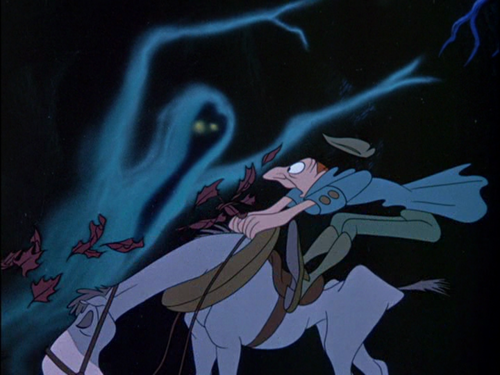
31 Days of Scary Movies: Disney’s “The Legend of Sleepy Hollow” 1949


 Of all the things I watched in October, Disney’s “The Legend of Sleepy Hollow,” the concluding segment to “The Adventures of Ichabod and Mr. Toad,” is one film that has perhaps been with me the longest. I believe I first came to it via “Disney’s Halloween Treat,”— the titan of Halloween nostalgia— which will come later in the month. But for more years than I can count, I’ve been watching the animated tale of Ichabod Crane and the ghost stories in Sleepy Hollow.”


 Washington Irving’s “The Legend of Sleepy Hollow,” is maybe my favorite ghost story. And I love ghost stories. The tale, about the fear of tales told in October and scary stories, about schoolmaster Ichabod Crane and his mysterious disappearance, is eternal and classic, and stands large over American horror. There is a lot in Disney’s short animated adaptation that shouldn’t work. Bing Crosby narrates, and he is iconic. Adding popular (at the time) songs to the animation sung by Crosby shouldn’t, on paper, work, but they do. And are incredibly charming. The segments of song with Ichabod, Katrina van Tassel and Brom Bones are always a delight to watch, and do a lot of character work to set up the mystery at the end. 


 Perhaps my favorite song is “The Tale of the Headless Horseman,” told by Brom Bones at the Halloween party. The animation is beautiful, and a Halloween wonder to watch. As the night progresses, and Ichabod heads home after the scary ghost stories, the animation becomes even more affective and iconic. The house with the wind in the trees. Ichabod and his horse slowly galloping though the silent woods, the cemetery, and encountering the ghostly (?) Headless Horseman. 


 I love this film, and could watch it so often I watched it twice last night. Things I noticed on this watch, are being more aware that Ichabod lives in his school house, and the background design of his bed is so detailed; with his bed and books and teapots. Every scene— the ghost story, the autumn fields, the Horseman’s woods— are this detailed, and I would live in them if I could. 


Tuesday, October 26, 2021

31 Days of Scary Movies: “The Legend of Sleepy Hollow” (1949)


Next up we returned to Disney and returned to the village of Sleepy Hollow. Disney’s “The Legend of Sleepy Hollow” was made in 1949 as a short film, and packaged with the other, unrelated short film adaptation of “The Wind in the Willows,” and released together as one film, “The Adventures of Ichabod and Mister Toad.” In later years on television, they were shown separately—with Ichabod’s segment titled “The Legend of Sleepy Hollow.” For the purposes of our film series, I watched only the Ichabod portion, which clocks in under half an hour. 


Bing Crosby narrates—and sings--  this beautifully animated tale. While the songs are whimsical—“Katrina,” for instance—Disney does not, thankfully shy away from the spookier elements of the story, with the “Headless Horseman” song in which the ghost story is related to Ichabod, and culminating in the spectacularly animated conclusion of Ichabod riding home through the woods—and being chased by the Horseman himself. The animation is so detailed and wonderful—from the Horseman’s cemetery, through the woods, and over the bridge. The Horseman himself and his horse are fiendishly perfect.


Something I appreciate a great deal about this version, is while even the Horseman’s chase gets a little—well—cartoonish, they do not shy away from its ultimate conclusion, and in fact embrace the original story’s ambiguity as to Ichabod’s fate. Did he fall victim to the Horseman that night? Did he leave to start a new life? Is the Horseman a real ghost story or not? Disney leaves all of Irving’s original uncertainty—and becomes one of the best adaptations of the Horseman’s tale in the process.  


Saturday, October 23, 2021

31 Days of Scary Movies: “Sleepy Hollow” (1999)


While I have tried to be diverse about my selections for the film project, some names can’t help but show up multiple times. Some are just too essential to Halloween viewing to only make an appearance on one night. Director Tim Burton is one of those names, and he returned last night with his wildly October 1999 version of “Sleepy Hollow.” Starring Burton standard Johnny Depp as Ichabod Crane and Christina Ricci as Katrina Von Taseel—with a wickedly beyond perfect performance by Christopher Walken as the Headless Horseman—“Sleepy Hollow” is what is now quintessentially a Burton film, but one that stands all on its own.


  There is precious little in the film that is faithfully adapted from Washington Irving’s definitive American ghost story “The Legend of Sleepy Hollow.” Ichabod is not a school master but a detective from New York City, and there is no ambiguity over whether or not the Horseman is supernatural or Brom Bones playing a trick on Ichabod. But that is okay. This is a wild amalgamation of an American Halloween film—using Irving’s immortal ghost story as a jumping off point, this is part Halloween film filled with jack o’ lanterns and scarecrows, part mystery, part witch legend and part slasher film. The atmosphere of this film is dreamlike and brilliantly contained. The dreary October woods and Colonial villages are painstakingly recreated, and always a beautiful sight to take in. The Horseman himself is scary while being over the top but not too much so; in Walken’s few flashback scenes where he has his head, you know while watching them that no one else could play the Horseman like him. Depp is also spectacular, brilliantly modeling his detective Ichabod after Angela Lansbury’s “Murder She Wrote” character; a perfect choice for Ichabod as a detective, if there ever was one. Miranda Richardson is also wickedly wonderful in her role.


The physical horror here is also played up to a degree that Burton has rarely touched, but when he does he gets it perfectly right. The decapitations happen quick and furiously, and creates a world where at any moment the world turns still and the Horseman can charge out of the road, removing anyone’s head who is in his path. This effect could have misfired, but it is so effective and, truly, scary. Burton knows what he is doing, and uses blood the way the old Hammer horror films did; not constantly,  but when present shockingly over the top. Danny Elfman’s score for the film is also iconic, and used to great effect in this village of “Sleepy Hollow.” I have watched this version every October for many years, and will always continue to do so.


Monday, February 18, 2013

"Sunnyside," Washington Irving's Home; Terrytown, NY

 Back in October, I made one last stop before leaving Sleepy Hollow. While the running around and taking the last few photos I wanted to was the last thing I officially did in the Village of Sleepy Hollow, before heading back home and across the state, I stopped at Washington Irving's home, "Sunnyside" in Terrytown.

 I wasn't sure what to expect. I hadn't seen a photo of the house or grounds before heading there. I only knew it lay further down the Hudson than anywhere else I'd been in Terrytown during the weekend. You park-- or at least on the Columbus Day weekend-- in a parking lot of what I believe were corporate offices of Kraft Foods, and take a shuttle bus a few miles down the road, and turn onto a narrower, winding road surrounded by trees and near woods, and a few very large houses. Very large houses.

 You come at the end to a parking lot next to what I can only describe as an antique looking-garden, and a small house. There is a declining hill and several buildings, and the sizable house that is Sunnyside at the base of the slope, right on the Hudson. For twenty dollars you can make it onto the grounds, and take a tour of the house.

 In Sleepy Hollow the day before, another tourist had mentioned that Sunnyside seemed to be more geared toward children-- but I still wanted to go, see what it was like, and walk the grounds that were home to the talent who wrote the legend of the Horseman.

 Sunnyside does have a lot to offer children and families. The sprawling grounds offer room for all sorts of activities, and the crew that manages Sunnyside takes full advantage that fact. There is story-telling (which I sadly missed), crafts, a playground, even outdoor cutouts you can stick your face through and have your photo taken as Ichabod, the Horseman or Rip Van Winkle. Which I may or may not have partaken in. There was scarecrow making for the children-- something that I would loved to have done, regradless of my age. But this activity was apparently only for the little ones. Sadly.

 Washington Irving's house is neither extremely large or small. The grounds, even with children running around shouting in the distance, are cool and calming, and as you walk to the front door alongside the Hudson River, you know this is an ideal place for a writer to be. Work, live. You understand. I took several photos outside the house, but none inside; they were not allowed. The tour is quick, taking you in small groups to Irving's library and workspace, dining room, hallways and kitchen. In each room is a person dressed as a member of the household staff, and they speak of how Sunnyside was a fully functioning home and estate, with the Irving family, a staff or servants and raised livestock.

 After the tour you leave the kitchen you come out into the courtyard-- where there is a rather ominous looking small structure: Irving's ice house. Designed by the writer himself to look like a "Gothic chapel" the ice house was a necessary function the household depended on to store ice in for the home, for refrigeration purposes. Without knowing the function of the ice house, the place is quite odd looking-- a small and unusual elegant shack of sorts, with large saws on the wall.

 After walking around Sunnyside for a while, I came to the refreshment stand next to the gift shop. Where I may have had pie and hot apple cider, the last official event of my Sleepy Hollow weekend.

 I hope to go back to Sleepy Hollow, someday. What I wasn't able to do as tickets were sold out the entire time I was there and well before, was see The Great Jack O'Lantern Blaze, an attraction the woman at the Sunnyside refreshment stands attested to the worthiness of. "Blaze" takes place at the Van Courtlant Manor, and consists of more than 5,000 individually carved jack o'lanterns put together in a variety of displays. I would like to see that. And I would like to go back to the cemetery in Sleepy Hollow, and explore. More, take photos. Of course. Yes, I think I will go back there someday.

You can see my complete Photo Album for my "Sunnyside" visit here:
Sunnyside, Washington Irving's Home; Tarrytown, NY


And you can read all the posts from my Sleepy Hollow Weekend 2012 here. 


 One last note to leave the writing of Sleepy Hollow on, for now. Here is a photo of myself I couldn't resist taking the first night, the first time I saw the Horseman's bridge, the Old Dutch Church and the cemetery.


All Photos Copyright Bryan Ball Photography, All Rights Reserved. 

Sunday, January 13, 2013

Sleepy Hollow Cemetery, Nighttime Lantern Tour, October 2012

Sleepy Hollow Cemetery, past the Horseman's bridge. Through the gates. Twilight sets in. A slight breeze comes on the dark, lush trees. The smell of rain on the air. Early October chill. A sprawling historical cemetery, laying over trees and hills and river-- just explored, to be explored.

 Children on Christmas morning don't have this much fun. I made sure I had enough batteries to last even repeated changes, and that I was carrying only my camera and my phone. From the time I bought my ticket, until I walked up to the group gathered for the tour, I wondered how the lanterns would work. Would each of us get a lantern? Would every few people get one to carry? The tours were sold out for the weekend, and almost throughout the rest of the month, so I wasn't expecting a small, quiet group.

 There were enough lanterns to use one for every two people. I had the lantern I would carry as mine on the tour, gray and warm.

 In the album, I made a decision not to delete any photos. If I had a hard time taking everything in during the afternoon, walking the cemetery at night amped the urgency to snap my lens up endlessly. As a result, I'm left with out of focus, blurred, rainy, over exposed and poorly set up snap shots-- but I don't think they are all so bad. I realize my limitations in changing light-- but I felt I learned a lot on my feet walking the tour. As the night progressed, and the rain began to drizzle and the cold set on, I'm very happy that I was still able to take some of the shots I did. And the light and condensation set up some interesting, misty effects, which I do appreciate.

 One of my highest hopes for the tour was that our guide be good. My preconceptions at first got the better of me, and when I saw that our guide was younger, I briefly wished that maybe someone--- older, perhaps--with more knowledge, was going to be the one doing the talking. But our guide-- a school teacher, not unreminiscent of Ichabod Crane himself-- proved me swiftly wrong with his wide breaths of knowledge, ability and willingness-- to keep on talking, expanding and answering questions.


 Our tour, starting just as dark had set in, first took us to the gravesites of Francis Pharcelleus Chruch (the author of the famous editorial to a young girl "Yes, Virginia, there is a Santa Claus", and a mausoleum of an early 1900s couple with a tortured history. Oh, and we were also taken to the place where 80's band The Raomones filmed their video for "Pet Sematary" (from the soundtrack of the film version from the Stephen King's novel "Pet Cemetery").


When we came to Susie Hayt Dibble's monument, it began to rain, lightlty. I'll write about what our guide said of her in the post to come. But this was the moment that a woman in our group began to speak up-- not at the guide but loud enough to be heard-- about Susie Hayt, as if she knew her. She continued to talk as we walked the few paces down the road to the Lister monument which I wrote about in my previous post. Sadly, I don't have any nighttime photos of the Lister monument, because the batteries on my camera had just passed on to the next world, and I was quickly working to put fresh ones in, while listening to everything our guide was saying.


At the Lister monument, our guide was recounting what was known of the family. Edwin Lister, apparently, treated his widow quite badly in the will he left behind. She was left a small portion of his wealth, and his children were the benefactors of what remained. Because of this, our guide mentioned (while stressing the following is wholly conjecture) that many wonder if the woman in the Lister monument is his widow, clutching the will in misery. The woman in stone does appear to be in no state of grief, but rather shock or anger, even. Perhaps she or someone with a particular knowledge and agenda regarding the situation had some part in the creation of the monument, our guide supposed. Following the tour, when I tried reasearching the Lister family, an article in The New York Times from June 13, 1898 regarding the details of Edwin's will is easily accesible. The story of the will is true. "It gives to his widow $50,000, to be paid to her in cash when she vacates the Lister homestead, and the income from an additional $50,000 as long as she lives." Again, the woman, who had spoken up at the Hayt gravesite, spoke up. Paraphrasing from my memory, she said "Yes. That's exactly right. But she was hurt so much by what he did to her."

 For the rest of the tour, the woman was mostly silent, only occasionally commenting on a gravesite's energy. I do not know what types of abilities this woman may or may not have had, but I do know that while the tour couldn't possibility have been any more wonderful, it would have been far less interesting without her commentary.

 Something I may not have mentioned in my previous post is that I never found Washington Irving's grave during the day. Between being sidetracked by the cemetery's many beauties and sights, and fighting against my ever-draining batteries, I was looking for his section when the last of my daytime batteries gave out. I found it somehow fitting that I first saw his gravestone in the dark. A simple stone, set back from the road, among many others. With a veteran's flag. Behind his family's gate. Our guide was so informed on the life, work and legacy of Washington Irving, that I learned things I had never known about him, and wouldn't have gained from even my visit to his home the following day on the Hudson River. As a child, young Washington once met America's first president George Washington, his namesake. Irving first came to know Tarrytown and Sleepy Hollow after he was sent there by his parents when the 1798 outbreak of yellow fever occured in Manhattan. I couldn't take enough photos of the man who is respobsible for one of the world's-- and certainly America's-- most enduring ghost stories, where he rests simply among the gravestones; just within sight of the Horseman's bridge, where his Ichabod met his fate.

 A number of stops after Irving's, our guide stated we would next visit the former holding vault, which was no longer in use, and had been built in 1900. We would get to see the vault, our guide said, up close. We would get to go inside, too. This had me endlessly excited. He fumbled through his keys, looking for the right one as we approached the door, and each left our lanterns outside. There was enough room past the open, creaking door in the vault for all of us, and we gathered around and listened to our very Ichabod-like guide speak. The valut had been used, when needed, to hold remains. When graves were unfinished before people passed on, or needed to be held in the receiving vault, for whatever the reason.

In 1970, we were told, segments of the film "House of Dark Shadows" were filmed in and around the vault. The film, a continuation of the popular supernatural soap-opera featuring vampire Barnabas Collins, used the receiving vault as the tomb of Barnabas and his family, placing the name "Collins" on the face of the vault. Other segments were filmed at the Lyndhurst Estate up the road in Tarrytown. In one of the open tombs of the vault are kept several "Dark Shadows" mementos, among which are a photo of Barnabas, as portrayed by the recently deceased Jonathan Frid. A part of me did not want to leave the vault.

Outside the vault, it began to rain harder, lightly.

The next notable gravesite we came to was Andrew Carnegie's. One of the late 19th century's most major philanthropists, Mr. Carnegie had what was to me one of the most striking pieces of propety deep in the Sleepy Hollow Cemetery. While several of the roads around him have mammoth masoleums (the largest I've ever seen; photos don't do them justice), from the dark road we could see only a few trees, bushes, in what appeared to be a thicket. A path leads from the road, to an open clearing where a large Celtic cross stands marking the resting spot of him and his wife Louise Whitfield. What perhaps interested me most, however, about his gravesite was that a member of his household staff is included. Agnes Locerbie, listed as a beloved member of Mrs. Carnegie's staff for 42 years (roughly half her own life) lies in the clearing, over to the side, in the back. Her stone faces away from Mrs. Carnegie's.

 The tour went on from there to several of the massive masoluems of some of Mr. Carnegie's contemporaries and peers-- giants of industry and wealth in their era of American history. We heard stories of their successes, and their fights with the labor movement, and were generally wowed by the scope of their monuments. These structures are larger than many houses. One of the final ones, where you could step up and look inside with ease, the stone structure was covered in all varities of religious symbolism. "Perhaps he didn't want to take any chances," said our guide.

 At the final monument, we heard of how the man who built the mausoleum died after having contracted pnemonia in the rain. As the chill ever increased and the rain became more steady, it was quite appropriate when our guide said, "On that note, we should start to head back."

 The two hour tour at that point had gone on much longer than scheduled. While we walked back to our starting point, we passed, in the shadow of the masoluems where those titans of industry lie, the modest grave of early labor activist Samuel Gompers, among other notables I was sorry we did not have more time to learn about, and ask questions.

 In the rain, we came back to the tree where we started, and had to surrender our lanterns. I so wished I could have kept mine-- but it would have been very conspicuous if I had stuffed a fully lit lantern under my jacket.

 One by one, the lanterns were extinguished, and we headed out into the dark of the Sleepy Hollow October night.

 Afterward, wandering out in Sleepy Hollow, I-- at long last-- met the Horseman. Or the Horseman found me. Not too far from the bridge. As hard as I tried to get my picture with him atop his horse, the horse was having none of it, apparently.


You can see my entire Photo Album of the night here:

Sleepy Hollow Cemetery, Nighttime Lantern Tour

All Rights Reserved, Bryan Ball Photography, Copyright 2012

Monday, October 29, 2012

Exploring Sleepy Hollow, Sunday afternoon

  My first morning in the Sleepy Hollow area began by searching for somewhere to go for a run. Staying across the Hudson, just on the other side of the Tappan Zee Bridge, I found myself at a hotel in a section of Nyack, New York, that was conveniently located exactly at a thruway exit,  but in an area void of any proper sidewalks. I ran up one street, and the sidewalk ended. I ran along another, and in passing wished there were a cemetery somewhere nearby where I could run, as I do in Forest Lawn when I am at home. I ran not twenty seconds down another block, turned a bend-- and an enormous cemetery, set on a large hill, appeared before me. The gates were open, and I would find that the sprawling graveyard spanning the hill was more than large enough to run in, and had graves going back to the very early 1880's, at least. There was even an old plot for a family by the name of "Crane." At the very top of the cemetery, having ran up the hill, you can see over the Hudson River, to Tarrytown and Sleepy Hollow. 


 I was excited to head back over the bridge, pass through Tarrytown, and be in Sleepy Hollow, again. The plan was to wander around the village, see any sights there may be to see, and head to the cemetery. The night before, from what I could see of the cemetery from the Old Dutch Church, I thought I knew how big-- or, rather, small-- it actually was. The lantern tour was not until seven in the evening; I thought that after looking around the village, I could see what the full cemetery was like, and take it all in prior to the tour. 

 My first thoughts seeing the Hollow in daylight were, still, that the Horseman was everywhere. From the street signs, to the village hall-- to restaurants, the post office and fire department-- either he was there on horseback, or he was chasing poor, terrified Ichabod. It was also quietly amazing, pleasantly surprising how much the village, in 2012, feels like the opening lines of Irving's story. In my head, walking the streets, I heard the words "Not far from this village, perhaps about two miles, there is a little valley, or rather lap of land, among high hills, which is one of the quietest places in the whole world. A small brook glides through it, with just murmur enough to lull one to repose; and the occasional whistle of a quail, or tapping of a woodpecker, is almost the only sound that ever breaks in upon the uniform tranquillity."

The weather was calm. Even the wind was quiet-- and the dropping rain, sparing but ever present. The leaves continued to drift down from the trees, falling to pave the streets. There are several streets intersecting with the main road in the village, and the shops, stores, homes, restaurants and the like did not seem big, did not seem small-- just quiet. Very sleepy. "A drowsy, dreamy influence seems to hang over the land, and to pervade the very atmosphere." I could hear Irving's words very clearly. 

As I headed closer to the bridge, the church and the churchyard, I began to completely understand the influence a place like this can have, the spirit which makes tales such as the Horseman possible. "A drowsy, dreamy influence seems to hang over the land, and to pervade the very atmosphere. Some say that the place was bewitched by a high German doctor, during the early days of the settlement; others, that an old Indian chief, the prophet or wizard of his tribe, held his pow-wows there before the country was discovered by Master Hendrick Hudson." 


 In the daylight, it struck me how clear you can see Ichabod's path. Walking up the street, you see the bridge, the church and churchyard all in succession-- and, now, you even see a statue of the Horseman's chase, as if Ichabod will eternally be riding that way, for the bridge he will never reach. I imagine Washington Irving wouldn't be able to help being proud, if he were able to come back (from the churchyard) to the Hollow today-- and see that the legend he penned to paper has taken on such an immortal life, it nows stands literally in the spot which the fiction took place. It is an awesome thing, an aweseome feeling. 

 Finally, I came to the church again. The plan was to explore the cemetery on my own, in the daylight, in preparation for the tour. Before passing through the gates, I  met the tent sent up by the Old Dutch Church to sell souveniors and the like. Incredibly charming people, with wares that many of which were nicer and more interesting the the gift shop by the Horseman's Hollow I'd been to the night before. I bought their book on the cemetery, among other things-- and headed off to walk among Sleepy Hollow's graves. 
The street, the bridge, the church and churchyard- with the statue far right.


My full album of the afternoon (before the cemetery) here:

Sunday, October 9, 2011

Fall in Sleepy Hollow


"It was, as I have said, a fine autumnal day; the sky was clear and serene, and nature wore that rich and golden livery which we always associate with the idea of abundance. The forests had put on their sober brown and yellow, while some trees of the tenderer kind had been nipped by the frosts into brilliant dyes of orange, purple, and scarlet." 

 -Washington Irving, "The Legend of Sleepy Hollow"

 While doing my cemetery photo wandering this weekend, which I am readying to begin posting tomorrow, I had the random thought of how much I wanted to read Washington Irving's original tale of Ichabod Crane and the Headless Horseman. Always enamored with the tale, the above passage struck me as so beautifully representative of the glory of this season we are in.