Showing posts with label upstate NY cemeteries. Show all posts

Monday, July 9, 2012

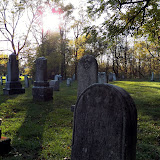
St. Paul's Lutheran Cemetery, October 2011


 It is July in upstate New York. Heat and bright pressure leans down, in a dry, lazy haze that seems to have always been, and will never go away. Engulfed in the summer now, my run this morning through Forest Lawn Cemetery involved pushing through air that has seemingly been replaced by raw heat-- everywhere.

 In other words, I miss October. I spent part of this afternoon looking at the vast expanses of my cemetery photography, and found this album I took last October in a small cemetery in a nearby suburb  which is not very far from my city, and not very far from the very rural area which surrounds us.


 St. Paul's Lutheran Cemetery was established in 1849, by the Amana Ebenezer Society. Some background on residents of Amana settlements. A religiously-based colony of people from Germany who emigrated to the United States in the mid 1800's, the Amana communities followed a Catholic tradition, and believe in peaceful, quiet work toward one's faith and values, rather than evangelizing the Christian Bible. With these beliefs in mind, the Amana or Ebenezers lived a communal life, entirely self-sufficient, until the 1930's. First living in New York (where this burial ground lies), they later moved mainly to Iowa, and have historically been mistaken for Amish peoples.

 Today, their graveyard lies next door to the Mayer Brothers Cider Mill and Store, an absolute and frequent autumn destination for yours truly. The red buildings seen in these photographs are the cider mill, where each September and October pumpkins adorn the decor, and the smells of cider, apples, pies and maple syrup carry over the darkening light and into the cemetery each October.

 In only mere months these photos will be a year old-- but there's a certain something here, among the orange and the falling leaves between the stones-- that help pass these long, hot summer days. When it feels as if October is so far away.


You may view my Photo Album of St. Paul's Lutheran Cemetery here:

St. Paul's Lutheran Cemetery, in October

Monday, February 20, 2012

The Mausoleum on the Hill


 Earlier in January, I ended up one Saturday in a section of Forest Lawn I'm not often in. Near one of the cemetery's lakes, there is a section filled with large, more modern mausoleums and statues-- some of which I have photographed before. Behind a row of medium sized mausoleums is a growth of trees and a riverbank, which leads to one of the quieter parts of the creek inside the cemetery. The spot is a safe little place ideal for quiet, thinking, calm.

 But I had never noticed what you can see there, up at the top of the hill on the opposite side of the area. One would think I hadn't noticed the mausoleum at the top before because of the heavy trees which, with their leaves, must surround and shroud the hill during the spring, summer and fall months.

 The mausoleum stood at the top of the hill, imposing. As I started to climb up the hill it stands on, I realized I'd never been up there before. And I'd picked the perfect day to start. The photos don't show how steep the hill actually is, I believe, and how difficult it was to climb through a fresh inch of snow up to the top. A newer section of the cemetery, most of the stones along the way were new, fresh and modern-- and contrasted with what lay at the top.

 Up close, the mausoleum is even larger than I'd expected. Though several random, separate markers populate the hill at the top, none appear connected to the mausoleum which bears no name. The Greek symbols/lettering for the Alpha and the Omega decorate the piece above the door-- and that is all. I searched for a name plate, a marker or something bearing a name, to no avail. Barring the slight possibility that something lays on the ground around the structure, the monument appears to be nameless. Once again, as so often within the cemetery, I was wondering. "Who were you?" 


 From the mausoleum, you are able to see much of this area of the cemetery. All of the section around the lake is visible-- and across the creek, to the first of the older sections of the cemetery, such as the one where the Pratt Monument lies. Behind the mausoleum, there is another steep hill down to the creek, with the cemetery's chapel directly on the other side.

 At the top you hear everything. All the sounds of the cemetery. The creek running around you, completely, surrounding you. The ducks and the geese from by the bridge. The wind in the trees. The silence of being in the middle of the vast cemetery. On this hill with what likely is the largest mausoleum in Forest Lawn, the mausoleum without a name.


You may view my photo album of the Hill here:

Forest Lawn, Hill, January 15, 2012

Sunday, February 5, 2012

Felix


Almost a year ago, one of my Forrest Lawn postings was about the famous Forrest Lawn buck, and his guarding of a goose and her goslings, while they incubated and hatched. The story of nature's simple beauty and dignity was often included on local news reports, and Forrest Lawn went so far as to install a 24 webcam for people to watch the mother goose and her deer protector.


 The buck has lived in the cemetery for the last few years, and he is absolutely one lucky deer, to have found the cemetery, and live within its enclosed, protective gates. The first time I met him, I instantly could sense his gentle spirit; unafraid of humans, though cautious, and eminently curious. While many different people have begun calling him many different things, I named him "Felix" after the author of the "Bambi" novel (in an attempt to be, somewhat, original.) 

 I've come to better know Felix on my runs and photo taking in the cemetery. Two weeks ago, with a fresh coat of snow over the cemetery, I found Felix by one of the cemetery's main gates and, coincidentally, a monument with a statue of a buck-- and it just so happened I had my camera.  

These are the results. He stayed still-- and not, it seemed, out of fear-- he seemed more curious in exactly what my camera was, and did not mind having the lens zoom in and out and so close to him. While photographs of a deer in the cemetery aren't exactly related to Halloween, Felix is a large part of what makes historic, majestic and fascinating Forrest Lawn the place that it is. I hope you'll indulge me. 

You may view my photo album here: 


Sunday, January 8, 2012

Who were you?


I've been spending yet more time than usual at Forest Lawn. For the last few months, I've fallen back into running, and on the weekends-- or the odd weekday I am not at work before the gates close at 5PPM-- I take my run through the winding, gorgeous hills of the cemetery. A blessing and a curse for me, I often stumble upon striking monuments I have never seen before, and unfortunately am quite a distance away from my car and camera. Some of them I come back for after my run, and most I remember exactly where I found them and am able to take some photographs.

 For a few weeks of running, I kept seeing the top of the Parker Monument, making a mental note of it, and (quite frankly) forgetting about it. Not until I came back with my camera for a stone nearby did I take a second, true look at this monument-- and realize that it is one of the more arresting pieces of statuary in Forest Lawn. I see many standards of monument art, and fall in love with them. Tropes such as the heavenward pointing finger, the books resting on stone trees or even the four angels such as those who adorn the Pratt Monument, are repeated, sometimes often.

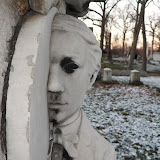
 I've never before seen anything like the Parkers' statues. A full, likely male figure-- suited and cloaked-- with a faded stone face, stands atop a base. The large stone bust of an older woman, Laura Parker (1803-1888) decorates the front, and to the sides on her left and right, two differing male busts stand (appearing to float), with halved profiles. The detail on the statuary of the base has beautifully stood the test of time. There is a small stone, impossible to read without a rubbing, which stands in front of the monument. The last fully legible date, under Laura's, name and likeness, is 1888. Unless the monument was erected much later than the last known death, the stone monument is, at the youngest, 123 years old.

 Part of my affinity for cemeteries is, as I've likely written about here, the beauty that is the living's tributes to those who have been lost. I wonder what it was that caused the Parker Monument to be made. Was it Laura's idea? Or one of these men-- her husband? Brother? Father? Sons? The family set up of a father, mother and two sons would appear the most logical-- but noticeably absent are any spouses the sons may have had. I wonder who the artist may have been, in 1880's Buffalo, NY, who had the original idea of the halved profiles. I wonder who these people were; what they did, what may be remembered beyond the stone, and what is not. Some of the stones I find at Forest Lawn are readily available on Goggle, with articles or at least brief summaries with some information on these long ago people. Not the Parkers. Searches on multiple search engines have returned only information on another person with the surname of Parker who is interred in the Red Jacket monument, and an entry in a publication from the Buffalo and Erie County Historical Society which mentions a Laura Parker, who's father was a general in the Civil War. The time frame certainly fits-- and, possibly, it may be the general standing on top of the stone. But I have found nothing concrete to confirm these Parkers are the same Parkers from the stone in Forest Lawn.

 I will keep looking, and post any updates I may find.

 View my Photo Album of the Parker Monument here: 

Forest Lawn, Parker Monument, 12-03 & 12-10-11

Wednesday, December 14, 2011

Missing October


 As the holly, the ivy and the mistletoe go up and the snow soon begins to fall, I thought I'd post a set of photos I took at Forest Lawn this past October.

 The following I took during the early afternoon of October 17. I had just discovered the different kinds of black and white options on my new camera, and enjoyed looking at old friends such as Silas Henry Fish, the Pratt monument and others through eyes of black and white.

 Part of me was torn between being able to capture Forest Lawn at it's most beautiful peak-- deep, bursting autumn oranges and reds and leaves--and capturing a different view, by using the black and white.

 The weather was a bit odd. The sun shone high and bright, while enormous gusts of wind rushed across the grass, taking leaves from the trees. All Hallow's Eve was only a few days away, and the cemetery was  extremely quiet. The only other person I saw was a Forest Lawn caretaker driving by.


You may view my Photo Album here:

Forest Lawn, 10-17-11 (Early afternoon wind, Black and White)


Sunday, November 13, 2011

Goodleberg Cemetery, Wales NY, in October


 Sacred grounds, cursed. The final resting place of American Revolutionary, Civil War veterans. A dismembering, elusive serial killer. An early 1900's abortion doctor, disposing of bodies in a nearby cemetery. In secluded, small-town America. And why, yes, there is a very good possibility it is the site of an ancient Native American burial ground. Also, evidence of satanic or otherwise dark rituals and vandalism have happened and been reported on the grounds.

 All these things make up the myth, legend and truth that surrounds Goodleberg Cemetery, in Wales, NY. About a half hour from my home, the legend of what happened and continues to occur around the small cemetery continually tops lists of the most haunted places in Western New York. For years I read local supernatural researcher and author Mason Winfield's writing on the subject, and, of course, grew up with bits and pieces of the legend. Naturally, Goodleberg was the perfect destination for an October cemetery this past month.

 Here is what I knew about Goodleberg going in. Sometime in the early 1900s, a doctor who performed abortions disposed of the bodies/fetuses and, on occasion, the body of a mother who did not survive the procedure, in and near a small, rural cemetery and its pond. Decades later, when serial killings took place throughout Western New York, pieces of the victims had turned up around the infamous doctor's cemetery-- and, of course, the land which housed the graves gained the reputation of being haunted, cursed, by the women and children the doctor had buried there.

 All this sounds like the elements of a decent, if not stellar, horror film. For, the stuff of local legends, while hardly ever true, makes great fiction. But. Most of Goodleberg's legend is true.

 Thankfully, we have Winfield's writing and research on the subject to confirm this, as even Goodleberg's Wikipedia page is quite sparse and uninformative, at best. And, quite perfectly, when my partner, friend and I made the trip to Goodleberg this past October, we ran into Winfield at a nearby coffee shop afterwards.

 The facts are among the following. Loosely translated, Goodlberg can mean "Hill of Ghouls." According to the website Dark Destinations, the term "ghoul" is an Arabic one, and it is argued that the name originates more from simply the surname "Goodle," as there is an early woman with the name interred there (although the website is lacking any proper citations.)

 Goodleberg's doctor was named Albert Speaker. According to Mason Winfield's research, Dr. Speaker (1880?-1948) appears to have been a "medical examiner," who acted as more of a coroner. Dr. Speaker had an office in Buffalo (not too far from my house) and a residence in South Wales, on Hunter's Creek Road, very close to Goodleberg. On our trip to the cemetery, we had thought the foundation of a house which can be seen from among the graves may have been Dr. Speaker's-- however, the home he lived in is still standing. It is apparently common knowledge among locals that Dr. Speaker performed abortions, most likely in his home. Whether this alone was enough to spring urban legends of disposed bodies in the nearby cemetery in pond, or whether these locals who have given life to the story are telling the truth-- it is not certain. No police evidence exists of any found bodies-- but, as with so many things about Goodleberg, so many macabre possible coincidences have come together over one, small, country-side cemetery. In his reasearch, Winfield has found the possibility that Dr. Speaker was connected to "crime elements," which may factor into his demise or some of the other, more grisly happenings around Goodleberg.


In October 1948, local papers reported that Dr. Speaker had died of a heart attack. Again, locals disagree, stating that his death was most likely a suicide (of hanging, by some reports, in a nearby tree) to avoid the shame of a trial. Whether this trial may have been connected to performing abortions or missing women, though, remains to be seen. Interestingly enough, Speaker is not buried in Goodleberg, but is interred in a New York City cemetery, by his surviving siblings. There does appear to be a documented connection between Dr. Speaker, the cemetery and at least one of the missing women who did turn up murdered. In August of that same year, Speaker's home was searched by police in connection with the disappearance of Helen Lindeman.

The pond, directly behind the cemetery.
 Some back story on Mrs. Lindeman. The wife of a prosperous dentist (who would have been involved in the same professional and social circles as Dr. Speaker), Helen disappeared while running errands in a small village suburb of Buffalo, NY. Body parts began to be discovered on Hunter's Creek Road five weeks later. Two weeks after that, a torso and head were discovered in remote areas of nearby Cattaraugus County. Dental records were used to identify the remains as that of Helen Lindeman. On Halloween of the same year, after the murder and death of Speaker, fire was set to Dr. Speaker's home. By who, we may never know. Someone trying to conceal evidence? A husband? Locals who knew or presumed to know more of the story?

Other murders in later years came to be linked with the Lideman murder, although no tangible connection ever surfaced aside from being discovered close to Goodleberg Cemetery.

Apparitions of all kinds continue to be reported around Goodleberg. There are reports of those who return to their cars and find small, children's handprints on their windows. Some have reported seeing a woman in black, who many connect to Helen Lindeman, as there were reports of people who thought they had seen her in the Goodleberg area after her disappearance and before her murder, hitch-hiking and wearing all black. Some have reported seeing the legendary large black dogs, or hell hounds. Though no homes stand on the side of the road the cemetery is on, houses are on the opposite both before and after the cemetery. Some locals have reported hearing strange chants in the cemetery at night, and finding strange, burnt markings in the ground and vandalism to the cemetery in the morning. And there are those who suggest that all this may be merely kids horsing around-- drinking, singing, smoking and desecrating the sacred grounds. While we absolutely found evidence of such vandalism, I, surely, still wonder. There simply seems to be something dark about the grounds which attracts other dark energy.


On a superficial level, I felt no such darkness walking through the cemetery. I felt a sadness, after having walked the road to the cemetery (after a car struck and killed someone walking on the road in more recent years, parking is not allowed directly by the cemetery), and saw the stones of these long-ago people turned over; cracked, smashed, vandalized and possibly lost to time. However, I would love to return to the cemetery-- perhaps at nighttime, if cemetery hours allow. I'm sure this won't be my last post on Goodleberg.


View my Photo Album of Goodleberg here: 

Goodleberg Cemetery


Read some of Mason's more in-depth writings on the history of the Cemetery HERE. 

Watch Mason discuss Goodlberg on a local program televised several years ago around Halloween:


Thursday, October 27, 2011

October in Forest Lawn, 2011

  Well, here begins my previously posted about trips to Western New York cemeteries during October. I have been keeping up with the trips, although they haven't as quickly translated into posts. While originally this was conceived as a weekly posting, I believe that this week leading up to Halloween will be Cemetery Week at Ghost Upon the Floor, and I'll update with new cemeteries ever day or so. I think it best to start chronologically, and start with my several trips to Forest Lawn I've made in these last few weeks of October.

 I photographed monuments, stones, angels, changing leaves and graves in what very well be my favorite cemetery. In the photo albums, which are more photo essays now, you will see things I've already photographed. Old friends such as the Pratt Monument and his angels make appearances, as do new statues and stones I discovered around the graveyard.

 While planting some deep fall colored mums in my recently discovered great-grandparents' urn in one of the cemetery's older sections, I discovered the grave pictured above, of Silas Henry Fish. Something just struck me about the way Silas' grave is constructed, on a shady hill, in his single, solitary above ground crypt. A huge cross lays on top of him, as opposed to the few stone flowers which adorn his wife's next to him. The first day of photography, as you can see above, I was there near sunset, and the sun setting shadows reminded me, for some reason, of the last act in Bram Stoker's "Dracula," as Jonathan Harker and company race the setting sun and the Prince of Darkness to his castle. When I returned a few days later for a series I will post later this week, I took several black and white photos of Silas Fish, and the stone work is even more striking and highlighted. I'm partial to the name Silas, too, I might mention, because of the character in Neil Gaiman's modern children's classic "The Graveyard Book." And this Silas lies on one of the most silent, peaceful hills in Forest Lawn.

 Always, I'm drawn back the short distance to the hill where the Pratt Monument stands. I took some shots of Pratt and his Angels in Autumn, and explored their section a bit more than before. Among the new stones I found were this pondering woman, who stands seated in a fenced in area among one of the older, circa 1900 areas of the graveyard. I'm ever fascinated by the artwork that lies within Forest Lawn. And however many times I visit the grounds, I always find some new beauty.


 I could spend hours among the stones, walking with my camera, finding and rediscovering new areas, art and the ways in which we remember those who have lived, and gone before us. I took far more photos than I have uploaded to the photo albums, but I tried to narrow the selection down to something I hope you, too, will find interesting-- a tour of the bright bursting orange autumn fall in this sprawling, magnificent cemetery.

View the photo albums from my first two trips below:

October in Forest Lawn, 2011
 
Fall in Forest Lawn Afternoon, 10-04-11


+

Saturday, September 24, 2011

October in the Cemeteries


 As you likely know, I love going to cemeteries, and spending hours there photographing the stones, monuments and other testaments we as humans leave behind to remember our lives and those whom we've loved. 

And there's no better time than October to photograph a cemetery. Which is why I have decided to visit one unique, upstate New York cemetery a week and document what I find, see and photograph here on the Floor. 

I have some interesting destinations ahead of me, some I've never been to-- and legends I've always wanted to check out. More than one of these cemeteries have been reportedly haunted--by many different people, over a great number of years. I plan on making my visits each weekend, and writing up the post on Saturday-Sunday. Fall is here, and I cannot wait to share the orange falling cooling dim harvest nights among the stones. 

Until then, I leave you with a brief video I took at Forest Lawn in July, of a small stone, circa 1800's, which caught my eye. 

Friday, September 16, 2011

Fall comes to Forest Lawn Cemetery

 This past weekend, I visited Forest Lawn again. Unlike trips of the past, where my intentions consisted only of wandering the cemetery, walking among the stones and finding new monuments and areas to photograph, this visit had a more specific purpose.

 I was looking for my great-grandparents' grave. My mother mentioned this to me the week earlier, and I was, of course, absolutely interested on where these relatives of mine were in the great cemetery. I've visited Forest Lawn so many times, but I'd never gone with the intention of finding a specific grave site.

 And so I set out on Saturday afternoon with my partner. The people at the office were extremely helpful, looking the names up on what appeared to be a DOS based system, and then going to a very large, very old, very heavy and very informative bound book of maps of the cemetery's different sections. I did not know what to expect, or guess where they could be. The woman at the desk gave me directions on the larger map of the cemetery to the section they were in, and a blown up guide of the section, with varying, possibly larger stones and monuments marked, in the hope I could use them to find my way to where my grandparents were.

 On our way I came across some interesting items of note. Autumn had begun to shine in the cemetery. Early fallen leaves crowded some of the roadways, and these gorgeous few leaves had begun to burn a bright orange red near section D, where my relatives were.

 I hadn't expected it to take long, but it began to take longer than I felt it should have. I took about 10 minutes to realize I was looking at the section map from the wrong angle, and once figured out, another ten to realize where the graves marked on the map where. I made my way through what I thought was a direct line to where my relatives should be... And I found a tree. A large tree, which literally encompassed several stones. Markers laid in the ground, toward the base of the tree, were almost covered with age and earth, and two stones stood back, behind the leaves.

 Around the tree, several stones I had to feel to read, as time had worn so much of the inscriptions away, appeared to have circa 1800 dates, and I began to wonder if my great-grandparents were among these older, nameless graves.


I was walking to the front of the section when I spotted their names, and found them.  By their own tree, in this older section of the cemetery, with decidedly unique designs and structures to their stones. A rough, well preserved, coral-like boarder lines their stones, and I have to say I've never quite seen something like that before. Their urn had a wildly strong weed growing out of it, and at the base, had a green plant which easily may have been planted when the stones were made. I intend to go back and clean up the urn a bit, perhaps put a new, fall-hearty plant in there. I snapped dozens of photos of my great-grandparents stones, and also of the surrounding area. I'm always fascinated that there are so many areas of the cemetery I haven't been in, and the unique beauty that lies within.

 You may view my photo album of the trip here.

Forest Lawn, 09-10-11 (Start of Fall, Trietleys)

Friday, August 26, 2011

Summer in Forest Lawn


I've posted quite a bit about my local Forest Lawn Cemetery, here in Buffalo, New York. In early July, I spent the larger half of a slightly overcast afternoon crawling the cemetery, taking photos and videos on my phone-- the visit was very spur of the moment.

It is possible I took hundreds of photos that day. Rather than overwhelming an entire post with even half of them, I've decided to break down the trip into segments.

I will begin with what I think is one of the most striking monuments in the sprawling cemetery. Forest Lawn's map describes Samuel F. Pratt, for whom the memorial is made, as "One of the greatest developers of Buffalo and its industries whose imposing memorial of great decorative beauty is set off by a group of angels."

View my photo album of the monument here: 

Forest Lawn, Pratt Memorial, 07-02-11

I know little to nothing about Samuel, although I believe a relative of his owed the house I live in during the 1800s. And I don't know if I would deem these women figures angels; they have a very, shall we say, earthly quality to their expressions and weights.