Wednesday, August 15, 2012

Pumpkins, again


Someday, I will grown a pumpkin. I've chronicled my past disappointments here, to varying degrees- my failure to be able to grow a pumpkin plant into a fully functioning and healthy being, capable of producing pumpkins. I don't believe I wrote about the extent of last year's failure-- nearly all of my many plants passing on to the next world before they even had a chance to flower.

 Needless to say, this year has been better. My Jack O'Lantern pumpkins I had so wanted to grow and carve did not survive. Several of the plants I bought at a local farmer's market-- pie pumpkins-- have been beacons of hope. They have flowered, and closed; flowered, and closed-- and I so hope they produce fruit.

 The record-setting drought we have had-- which I recently wrote about as it threatened the process of leaves changing in the fall-- I thought alone would have killed my pumpkins. But I have been giving the plants much water each day, and now am regularly spraying for bugs-- as I lost a plant early on to some evil creature which ate the plant whole, it seemed. Also, the location I planted these in, I know, are not ideal-- but they have nevertheless progressed farther than I have ever made it before.

 Here's to something of a crop, I hope, in time for fall.

Sunday, August 12, 2012

Voodoo


 My friend Laura is awesome. From her recent trip to New Orleans, Louisiana, she brought me back this skull from the Marie Laveau's House of Voodoo Gift Shop. I'm not sure if this skull is specifically related to Voodoo, or strictly the Day of the Dead, or both-- but it has ignited an interest in the subject of what the Voodoo religion is-- its history, myth and-- like any religion-- occasional relation to the occult.

 Voodoo, I've come to learn, is a more umbrella term for a number of religious practices which originated during the tragic time in our history known as the African diaspora-- when African people were enslaved and brought to America. There are several voodoo traditions-- Haitian and Louisiana among them-- and the one I've now read most about is Louisiana Voodoo. Voodoo came to Louisiana by way of African, Haitian and French cultures mixing in this central place. From the influence of the French (Louisiana, at the time, being a French colony), Voodoo gained a considerably Catholic influence, resulting in spirits existing in Voodoo who were  called by their African names, but later took on the names of Catholic figures and saints. Among more modern practitioners of Voodoo, there is even a movement to canonize Marie Laveau, the famous Voodoo Queen who lived from 1784 through 1881. 

 Why, then, has Voodoo become, in some areas, so synonymous with the supernatural? Largely, this appears to be from the often intertwined aspects of the religion with the practice of Hoodoo, which is loosely defined as African folk magic. Voodoo Queens such as Marie Leaveau became famous for their legends, which contained the practicing of spells and other mystical dabbling-- a legend that lives on today, as visitors to the tomb of Marie Leaveau continue to write "XXX" on the walls of her tomb in the hope the Voodoo Queen of the 1830's will grant them a wish.

 Similarly, the concept of a "voodoo doll" has become representative of voodoo, however with origins not easy to trace. The practice of sticking pins in a doll appears to have originated more in the folk magic of Hoodoo, while being often linked to the world of Louisiana Voodoo. In New Orleans Voodoo, the voodoo doll is a form of "gris-gris," or invoking the spirits-- and, surprisingly, have historically been used more as a talisman for luck than for the infliction of pain and or misfortune on one's enemies. The folklore around the voodoo doll-- used both for luck and revenge-- is extensive, and it is easily apparent how tales such as using a doll to call upon spirits for deeds dark or light find an easy home in the supernatural.

 Zombies also have a like history to voodoo. Tales of the zombie, the dead brought to life, appear most commonly found in the folk magic associated with Haitian Voodoo-- or, more accurately, the legends and mythologies born out of such practices-- and the tales of these spirits being called upon to bring back the dead to us is absolutely a task of the supernatural.

 There is so much to this topic I see the creation of many future blog posts to do this justice; exploring what the religion of Voodoo is, and how its customs birthed such dark, varying and interesting legends.

 Someday, I will make it to New Orleans.

Images: Marie Leaveau's Tomb / Voodoo doll

Thursday, August 2, 2012

An August Danse Macabre


It is August. The unofficial start to fall, two months out from the pumpkin month. By the time this month is out, we will have started to see the first of the leaves turn, and felt the first chill on the air (hopefully.)

 Many times in the past, I have posted about Saint-Saens' "Danse Macabre" and differing videos   the piece has spawned, such as this one. For me, there are few, if any, themes more appropriate to ring in the season.

Tonight, I give you a performance I consider very strong of the piece that is as synonymous to Halloween for me as October air.


Thursday, July 26, 2012

Running out of time...


 Still more than a month out from September, more first sightings bring harvest-scented joy-- and a fair share of terror that time is running out and, again this year, I will not have time enough to get ready for October 31.

Michael's has been one of the first to put out there All Hallow's wares for the last few years-- and while what they do have out is nothing revolutionary and new, I do rather like the skeletons and vintage-themed potion bottles I saw this past weekend. 


 I did not purchase anything, though-- yet.

Soon. The season is coming.


Friday, July 20, 2012

Something very, very wicked...


 I give you, the true face of evil. Running through the cemetery this past week, I noticed how, on a hill where there are sparse trees, the leaves of the trees had begun to fall. Off there branches, crunchy, colorless and dead. Leaves with the texture of November, but without even the slightest hint of the deep oranges and reds the changing colors bring.


 Apparently, my area of upstate New York has been having the worst dry spell since the 1950's. Any threat to any part of autumn happening is an unspeakable horror, in my book. Think: Christmas being cancelled for a young child-- but one thousand times worse.

 I am hoping this does not go on much longer, and hoping that we get some much needed water pouring down from the sky very soon. We must have fall, in all its glory.


Monday, July 9, 2012

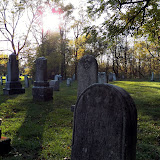
St. Paul's Lutheran Cemetery, October 2011


 It is July in upstate New York. Heat and bright pressure leans down, in a dry, lazy haze that seems to have always been, and will never go away. Engulfed in the summer now, my run this morning through Forest Lawn Cemetery involved pushing through air that has seemingly been replaced by raw heat-- everywhere.

 In other words, I miss October. I spent part of this afternoon looking at the vast expanses of my cemetery photography, and found this album I took last October in a small cemetery in a nearby suburb  which is not very far from my city, and not very far from the very rural area which surrounds us.


 St. Paul's Lutheran Cemetery was established in 1849, by the Amana Ebenezer Society. Some background on residents of Amana settlements. A religiously-based colony of people from Germany who emigrated to the United States in the mid 1800's, the Amana communities followed a Catholic tradition, and believe in peaceful, quiet work toward one's faith and values, rather than evangelizing the Christian Bible. With these beliefs in mind, the Amana or Ebenezers lived a communal life, entirely self-sufficient, until the 1930's. First living in New York (where this burial ground lies), they later moved mainly to Iowa, and have historically been mistaken for Amish peoples.

 Today, their graveyard lies next door to the Mayer Brothers Cider Mill and Store, an absolute and frequent autumn destination for yours truly. The red buildings seen in these photographs are the cider mill, where each September and October pumpkins adorn the decor, and the smells of cider, apples, pies and maple syrup carry over the darkening light and into the cemetery each October.

 In only mere months these photos will be a year old-- but there's a certain something here, among the orange and the falling leaves between the stones-- that help pass these long, hot summer days. When it feels as if October is so far away.


You may view my Photo Album of St. Paul's Lutheran Cemetery here:

St. Paul's Lutheran Cemetery, in October