Thursday, January 19, 2012

Darkness there, and nothing more


Happy Birthday, Edgar. Today, the man-- who's work I was initially drawn to in childhood because it was dark, different, and drawn back to as I grew older because I came to realize so many of the things he understood so beautifully-- would have been 203 years old.

Image: Associated Press
 There's something sadder about this birthday, however; a sadness one might see Poe himself as having dreamed up. The man who lived his life and wrote his work tormented by and fighting against the raven-- that specter of eternal sadness, of absolute death-- would, I think, find this almost fitting. While Poe's work has gained him an immortal status in the literary canon and following throughout the world and history, it is the personal nature of his writing which, I believe, draws readers time and again to him.

 And that has much to do with the tradition of the "Poe Toaster." As I have written about here these last few years, from the 1940's until 2009, an unknown man dressed in black would, in the early hours of the morning night of Poe's birthday, leave a bottle of cognac with a rose at the poet's grave.

Fans of Edgar would wait all night to witness the event, and this tradition lasted more than 60 years. In the 2000's, however, it became rumored that the original toaster had passed away, and left the tradition to a son or some different person. This new toaster created some controversy, including notes indicating political beliefs and opinions on sports teams-- which, it appeared, seemed to go a long way in turning many off to what the tradition had become.

 While people have gathered to keep watch for Poe's toaster these last three years, no such man in black has shown. And this year the Poe House and Museum curator declared the tradition officially over. Though I doubt that declaration will have much sway over the die-hard fans; people who, I can so easily see, would return year after year to the Baltimore cemetery, just in case the toaster were to return for Edgar. 

 I hope one day I'm one of them.

Sunday, January 8, 2012

Who were you?


I've been spending yet more time than usual at Forest Lawn. For the last few months, I've fallen back into running, and on the weekends-- or the odd weekday I am not at work before the gates close at 5PPM-- I take my run through the winding, gorgeous hills of the cemetery. A blessing and a curse for me, I often stumble upon striking monuments I have never seen before, and unfortunately am quite a distance away from my car and camera. Some of them I come back for after my run, and most I remember exactly where I found them and am able to take some photographs.

 For a few weeks of running, I kept seeing the top of the Parker Monument, making a mental note of it, and (quite frankly) forgetting about it. Not until I came back with my camera for a stone nearby did I take a second, true look at this monument-- and realize that it is one of the more arresting pieces of statuary in Forest Lawn. I see many standards of monument art, and fall in love with them. Tropes such as the heavenward pointing finger, the books resting on stone trees or even the four angels such as those who adorn the Pratt Monument, are repeated, sometimes often.

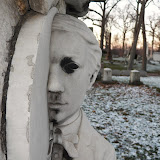
 I've never before seen anything like the Parkers' statues. A full, likely male figure-- suited and cloaked-- with a faded stone face, stands atop a base. The large stone bust of an older woman, Laura Parker (1803-1888) decorates the front, and to the sides on her left and right, two differing male busts stand (appearing to float), with halved profiles. The detail on the statuary of the base has beautifully stood the test of time. There is a small stone, impossible to read without a rubbing, which stands in front of the monument. The last fully legible date, under Laura's, name and likeness, is 1888. Unless the monument was erected much later than the last known death, the stone monument is, at the youngest, 123 years old.

 Part of my affinity for cemeteries is, as I've likely written about here, the beauty that is the living's tributes to those who have been lost. I wonder what it was that caused the Parker Monument to be made. Was it Laura's idea? Or one of these men-- her husband? Brother? Father? Sons? The family set up of a father, mother and two sons would appear the most logical-- but noticeably absent are any spouses the sons may have had. I wonder who the artist may have been, in 1880's Buffalo, NY, who had the original idea of the halved profiles. I wonder who these people were; what they did, what may be remembered beyond the stone, and what is not. Some of the stones I find at Forest Lawn are readily available on Goggle, with articles or at least brief summaries with some information on these long ago people. Not the Parkers. Searches on multiple search engines have returned only information on another person with the surname of Parker who is interred in the Red Jacket monument, and an entry in a publication from the Buffalo and Erie County Historical Society which mentions a Laura Parker, who's father was a general in the Civil War. The time frame certainly fits-- and, possibly, it may be the general standing on top of the stone. But I have found nothing concrete to confirm these Parkers are the same Parkers from the stone in Forest Lawn.

 I will keep looking, and post any updates I may find.

 View my Photo Album of the Parker Monument here: 

Forest Lawn, Parker Monument, 12-03 & 12-10-11

Saturday, December 24, 2011

Marley was dead.

 The season of the ghost is now upon us. Again? I've written about this before, of the uncanny connection between the Christmas holiday and the day which is the reason for this blog existing. The progression is a natural, if not often thought of one; All Hallow's Eve is celebrated on the verge of the major change, the summer's abundance ending, with the fear and knowledge that the end is coming, the nights growing longer, on the ever chilling wind. Halloween leads into the season where our weather is (in climates which allow) the coldest, the most severe, the darkest. And this is where Christmas happens.

 Christmas itself is a study in contrast. What is generally celebrated as the feast of light, good-will and peace among women and men happens in the dead of winter, when the earth and world are barren and frozen. Families travel to be together during the times of the year which can bring the harshest weather for traveling, and there is a mad rush to give-- to others, our family and friends.

 I think Charles Dickens lighted onto this concept of what Christmas was, and penned "A Christmas Carol." For the modern world, it's hard to imagine a Christmas season without "A Christmas Carol"-- whether in the original novella form, or the numerous film and television adaptations the classic has seen. What would appear the definitive story about the celebration of Christmas is, frankly, a story where a miserable man is literally haunted by Christmas personified as actual, from-the-grave ghosts. In other words, "A Christmas Carol" is about a man, Ebenezer Scrooge, who is so miserable and cold to the world he lives in Christmas sees no choice but to terrify him, and shake him out of his wicked ways. While Scrooge is alive, his soul is dead. And while his ex-business partner Marley is dead, he returns to Scrooge with a message more alive than the both of them.

 It would appear Mr. Scrooge needed a little Halloween to show him what Christmas is all about, Charlie Brown.

 What works so perfectly about the tale is that Christmas is so full of ghosts-- the ghosts of our past, our childhood, those and that which have come before. The year-ending season is a time to stop. And think. About the Christmases of the past- who was with us, what we might have done, and what we may have wished we had done. While Marley serves as a frightening specter to Scrooge because, in life, Scrooge knew him, and now must witness the ghostly fright that is his existence after death-- the Ghost of Christmas Past haunts Scrooge (and us) because of the many forms the ghost takes. Often depicted as a candle, or with either a candle or candle-stopper, the ghost always haunts, fragile and fleeting, because she was here-- and will always remember. Never be able to be changed.

 Her successor, the Ghost of Christmas Present, was and has continued to be a manifestation of the modern Christmas spirit-- a very much St. Nicholas/Santa Claus type of spirit-- bearded, joyful and abundant in laughter, good will (and size.) But at the same time, the ghost is deeply reflective, offering biting critiques on society, in addition to his jovial nature. This ghost's haunting is different-- haunting to Scrooge and us all by making us aware of our surroundings-- the joy of the season, the suffering of the less fortunate in the world, like the Crachitt family. And lastly, the Ghost of Christmas Yet to Come haunts us when we think of the ghosts of the past, the ghosts of the present-- and what they mean if they remain unchanged. This ghost, nearly always depicted as a Grim Reaper or similarly hooded figure (and, in an original twist in the recent Disney animated adaptation, as simply a shadow never seen) scares-- or, rather, makes him aware-- Scrooge into the knowledge of the nature of his ways, by literally bringing him to the grave. Where all the memories of Christmases past and present will end, without opportunity to change them for the better.

 And so. While Christmas has become not only a Christian holiday, but developed a secular following and celebration around the season of giving gifts-- I wish you a Merry Christmas. And all the comes with it.

Happy haunting, if your need be.


Images: Behind the Thrills & Brett Helquist

Wednesday, December 14, 2011

Missing October


 As the holly, the ivy and the mistletoe go up and the snow soon begins to fall, I thought I'd post a set of photos I took at Forest Lawn this past October.

 The following I took during the early afternoon of October 17. I had just discovered the different kinds of black and white options on my new camera, and enjoyed looking at old friends such as Silas Henry Fish, the Pratt monument and others through eyes of black and white.

 Part of me was torn between being able to capture Forest Lawn at it's most beautiful peak-- deep, bursting autumn oranges and reds and leaves--and capturing a different view, by using the black and white.

 The weather was a bit odd. The sun shone high and bright, while enormous gusts of wind rushed across the grass, taking leaves from the trees. All Hallow's Eve was only a few days away, and the cemetery was  extremely quiet. The only other person I saw was a Forest Lawn caretaker driving by.


You may view my Photo Album here:

Forest Lawn, 10-17-11 (Early afternoon wind, Black and White)


Monday, December 5, 2011

Merry Krampuslauf


I had no idea until earlier today of the legend of Krampus. A character seemingly more at home in the dark nights of October, the Krampus myth lives throughout the countries of the Alps. Legend has it, that Krampus travels with Saint Nicholas during the Christmas season-- giving warnings or punishments to children who have been bad, while Nicholas rewards the good with presents.

 Krampus, simply put, is one scary beast. Traditionally, he is depicted as a devil-like, horned demon creature. In some areas of the Alps, on December 5, young men will dress like Krampus and scare children by shaking bells and chains. Think of a more vengeful, angry, horned Marley's ghost hell-bent on terrorizing children.


Sounds just like Christmas to me. Or, how Christmas should be. I don't know about you, but if this creature came to my door, I'd be begging Saint Nicholas to just leave me coal.


 And here's some video from YouTube of what Krampus looks like and is, in modern times. I believe this will be the first in a series of posts that examines the many, shall we say, similarities between Christmas and the holiday I prefer.

If only we had Krampus in America.


YouTube User: MOSHV4L

Second Postcard Image via Derek Nobbs @ Anachronistic Decay 

Sunday, November 13, 2011

Goodleberg Cemetery, Wales NY, in October


 Sacred grounds, cursed. The final resting place of American Revolutionary, Civil War veterans. A dismembering, elusive serial killer. An early 1900's abortion doctor, disposing of bodies in a nearby cemetery. In secluded, small-town America. And why, yes, there is a very good possibility it is the site of an ancient Native American burial ground. Also, evidence of satanic or otherwise dark rituals and vandalism have happened and been reported on the grounds.

 All these things make up the myth, legend and truth that surrounds Goodleberg Cemetery, in Wales, NY. About a half hour from my home, the legend of what happened and continues to occur around the small cemetery continually tops lists of the most haunted places in Western New York. For years I read local supernatural researcher and author Mason Winfield's writing on the subject, and, of course, grew up with bits and pieces of the legend. Naturally, Goodleberg was the perfect destination for an October cemetery this past month.

 Here is what I knew about Goodleberg going in. Sometime in the early 1900s, a doctor who performed abortions disposed of the bodies/fetuses and, on occasion, the body of a mother who did not survive the procedure, in and near a small, rural cemetery and its pond. Decades later, when serial killings took place throughout Western New York, pieces of the victims had turned up around the infamous doctor's cemetery-- and, of course, the land which housed the graves gained the reputation of being haunted, cursed, by the women and children the doctor had buried there.

 All this sounds like the elements of a decent, if not stellar, horror film. For, the stuff of local legends, while hardly ever true, makes great fiction. But. Most of Goodleberg's legend is true.

 Thankfully, we have Winfield's writing and research on the subject to confirm this, as even Goodleberg's Wikipedia page is quite sparse and uninformative, at best. And, quite perfectly, when my partner, friend and I made the trip to Goodleberg this past October, we ran into Winfield at a nearby coffee shop afterwards.

 The facts are among the following. Loosely translated, Goodlberg can mean "Hill of Ghouls." According to the website Dark Destinations, the term "ghoul" is an Arabic one, and it is argued that the name originates more from simply the surname "Goodle," as there is an early woman with the name interred there (although the website is lacking any proper citations.)

 Goodleberg's doctor was named Albert Speaker. According to Mason Winfield's research, Dr. Speaker (1880?-1948) appears to have been a "medical examiner," who acted as more of a coroner. Dr. Speaker had an office in Buffalo (not too far from my house) and a residence in South Wales, on Hunter's Creek Road, very close to Goodleberg. On our trip to the cemetery, we had thought the foundation of a house which can be seen from among the graves may have been Dr. Speaker's-- however, the home he lived in is still standing. It is apparently common knowledge among locals that Dr. Speaker performed abortions, most likely in his home. Whether this alone was enough to spring urban legends of disposed bodies in the nearby cemetery in pond, or whether these locals who have given life to the story are telling the truth-- it is not certain. No police evidence exists of any found bodies-- but, as with so many things about Goodleberg, so many macabre possible coincidences have come together over one, small, country-side cemetery. In his reasearch, Winfield has found the possibility that Dr. Speaker was connected to "crime elements," which may factor into his demise or some of the other, more grisly happenings around Goodleberg.


In October 1948, local papers reported that Dr. Speaker had died of a heart attack. Again, locals disagree, stating that his death was most likely a suicide (of hanging, by some reports, in a nearby tree) to avoid the shame of a trial. Whether this trial may have been connected to performing abortions or missing women, though, remains to be seen. Interestingly enough, Speaker is not buried in Goodleberg, but is interred in a New York City cemetery, by his surviving siblings. There does appear to be a documented connection between Dr. Speaker, the cemetery and at least one of the missing women who did turn up murdered. In August of that same year, Speaker's home was searched by police in connection with the disappearance of Helen Lindeman.

The pond, directly behind the cemetery.
 Some back story on Mrs. Lindeman. The wife of a prosperous dentist (who would have been involved in the same professional and social circles as Dr. Speaker), Helen disappeared while running errands in a small village suburb of Buffalo, NY. Body parts began to be discovered on Hunter's Creek Road five weeks later. Two weeks after that, a torso and head were discovered in remote areas of nearby Cattaraugus County. Dental records were used to identify the remains as that of Helen Lindeman. On Halloween of the same year, after the murder and death of Speaker, fire was set to Dr. Speaker's home. By who, we may never know. Someone trying to conceal evidence? A husband? Locals who knew or presumed to know more of the story?

Other murders in later years came to be linked with the Lideman murder, although no tangible connection ever surfaced aside from being discovered close to Goodleberg Cemetery.

Apparitions of all kinds continue to be reported around Goodleberg. There are reports of those who return to their cars and find small, children's handprints on their windows. Some have reported seeing a woman in black, who many connect to Helen Lindeman, as there were reports of people who thought they had seen her in the Goodleberg area after her disappearance and before her murder, hitch-hiking and wearing all black. Some have reported seeing the legendary large black dogs, or hell hounds. Though no homes stand on the side of the road the cemetery is on, houses are on the opposite both before and after the cemetery. Some locals have reported hearing strange chants in the cemetery at night, and finding strange, burnt markings in the ground and vandalism to the cemetery in the morning. And there are those who suggest that all this may be merely kids horsing around-- drinking, singing, smoking and desecrating the sacred grounds. While we absolutely found evidence of such vandalism, I, surely, still wonder. There simply seems to be something dark about the grounds which attracts other dark energy.


On a superficial level, I felt no such darkness walking through the cemetery. I felt a sadness, after having walked the road to the cemetery (after a car struck and killed someone walking on the road in more recent years, parking is not allowed directly by the cemetery), and saw the stones of these long-ago people turned over; cracked, smashed, vandalized and possibly lost to time. However, I would love to return to the cemetery-- perhaps at nighttime, if cemetery hours allow. I'm sure this won't be my last post on Goodleberg.


View my Photo Album of Goodleberg here: 

Goodleberg Cemetery


Read some of Mason's more in-depth writings on the history of the Cemetery HERE. 

Watch Mason discuss Goodlberg on a local program televised several years ago around Halloween:


Sunday, November 6, 2011

Remembering Edgar on El Dia de los Muertos


I've always been intrigued by the Mexican holiday El Dia de los Muertos (the Day of the Dead.) Celebrated on November 1 and 2 to commemorate the Catholic holy days of All Saints Day and All Souls Day. Now celebrated actively throughout the world, the day has pagan roots, dating back to an Aztec festival dedicated to Mictecacihuatl, the goddess of the underworld.

 Every year a local art gallery, El Museo, celebrates the festival with an exhibition "Altars" featuring all kinds of locally done altars. When my good friend Kitty, who manages the gallery, asked if I was interested in being a part of the exhibit this year, I initially jumped at the chance without a clear idea of what I would do. I first had several different people in mind to memorialize in an altar, but when I thought of doing one for my good friend Edgar Allan Poe, a series of ideas came to me and I knew I had to do one for Edgar.

 My first experience doing an art project for a show since elementary school, I had an amazing amount of fun putting this together. The concept of a Day of the Dead altar is creating a display of objects commemorating a departed person's life, which in Mexico traditionally uses sugar skulls and other food objects. Unsure of how to incorporate a sugar skull, the first idea I had was to use some kind of alcohol or brandy for Edgar. The clear choice became the cognac the traditional Poe Toaster, until recently, left on Edgar's grave during the early morning night hours of his birthday, alongside a rose. Each object seemed to flow into the next-- when I thought of the cognac, I pictured the shot glasses standing on stacked bricks from "The Cask of Amontillado," standing in front of the altar.

 I initially wanted to use a photograph of Edgar, but when I thought of which to use, one that wouldn't be too conventional or standard, I had the small revelation that in order to commemorate the life and work of Edgar Allan Poe, the altar should be toward his wife, Virginia Eliza Clemm Poe. His devoted wife, Virginia stands over so much of Poe's body of work. His love for her, and her untimely death at the hands of tuberculosis, created much of his most famous work. Virginia is the maiden Annabel Lee, the long lost Lenore and, I believe the source of the intense fear of death and disease Poe explored in his writing throughout his life. And so, I needed a photograph of her. Which presented a problem, as there is no entirely confirmed photograph of Virgina; only paintings and sketches done after her death. I took the most famous painting, and used photo software to try and make the picture look like a Poe-era photograph. The framed piece became a center of my altar.

 Once put together, the base of the altar was covered by white cloth and frayed grey cloth sold in stores this time of year as "Halloween/creepy cloth." For the surface I used pieces of scrap wood dyed to appear older, for the floor boards from "The Tell-Tale Heart," which, through an opening, holds, in a bed of manuscript pages of Poe's work, a heart. The heart of the old man, and also, in my altar's case, the heart of Poe's work, his love for Virginia. Scattered about the altar are raven feathers, which appear throughout his work; the idea of the raven, that once lost, those we love are lost forever. The manuscript pages I made I took from "The Raven," "Annabel Lee," "Alone," "The Tell-Tale Heart" and "The Black Cat," and all from passages relevant to Virginia and Edgar's relationship.

 All in all, I absolutely loved doing this piece, "Quoth the Raven." Exploring what makes Edgar's work on life, love and death is central to the concept of the Day of the Dead, and to create something, an altar, to memorialize his and Virginia's contribution to the world was a great experience. I was proud to be a part of the exhibit that also held great pieces commemorating lost loved ones, pets, community members, well-known people and even the victims of World War II's holocaust. For anyone who may be in the Buffalo area, the exhibit will be at El Museo through November 25.

You may view my Photo Album of making the piece and the opening here:

Poe Altar, "Altars" Opening, El Dia de los Muertos