Sunday, October 3, 2021

“Books of Blood Volume One” by Clive Barker


  When I posted earlier this weekend about my All Hallow’s Eve Reading List, I felt like I’d have no chance of finishing it all by October 31. Well, I still have my doubts, but I am now one closer to that lofty goal. 


  Clive Barker has quickly become one of my favorite writers. He has an ability all his own to create some of the most beautiful writing out there, but does so while including absolutely horrific, deeply disturbing and graphic horror.  The short stories in this collection are gory, visceral, disturbing and beautifully written. Barker is a master at grabbing you attention and holding you with brilliant first lines and openings. Breaking them down… 

“The Book of Blood”

This story is more of a framing device for the stories that come after, although it is one of the best in the book. Something only Barker could write, of sprits begging to be heard.

“The dead have highways. They run, unerring lines of ghost-trains, of dream-carriages, across the wasteland behind our lives, bearing an endless traffic of departed souls. Their thrum and throb can be heard in the broken places of the world, through cracks made by acts of cruelty, violence and depravity. Their freight, the wandering dead, can be glimpsed when the heart is close to bursting, and sights that should be hidden come plainly into view.”

“The Midnight Meat Train”

This serial killer tale is a super original take on the genre, coupled with absolutely disgusting and horrific scenes that amount to interesting social commentary. 

“The Yattering and Jack”

A demon is sent to collect a soul, and runs in to trouble. This was one of my favorites of the group. 

“Pig Blood Blues”

A new teacher at a boarding school uncovers secrets, and a pig. A fascinating read, not my favorite of the group. 

“Sex, Death and Starshine”

 This was a weird one, even by Clive Barker’s standards. Engrossingly written, and I loved sections of this, though I wasn’t always sure what it was amounting to. 

“In the Hills, The Cities” 

 A gay couple on the rocks traveling in Europe, encountering local customs. Absolutely bizarre, grotesque and very well done. 

 All in all a great collection, and I will quickly read the rest of the volumes in this series.

Saturday, October 2, 2021

31 Days of Scary Movies


 This Halloween, the Ghost is all about planning. More than a month ago, I took a calendar for October, and tried to fill each day with a scary or otherwise Halloween related movie. I had quickly filled the month, lucky that I’d used a pencil, and was able to erase films that had to be bumped for something else. Like my reading list, I tried to be as thoughtful as possible about about what made the cut. 


 I left off movies that I wish I’d had room for. The standards are there— 1931’s Frankenstein, 1978’s Halloween— and I often found myself able to select only one of two childhood animated favorites or entries from a franchise. 

 Last night, for the first night, I watched one of the very first Universal Monsters horror films: Tod Browning’s “Dracula,” from 1931. One of my eternally favorite horror films, it was a natural inaugural choice. The film is so ethereal, dream like and atmospheric. While the temperatures dipped and the wind picked up outside, I once again watched Bela Lugosi give one of film’s major performances, that would cement so much about horror and Halloween— Count Dracula, haunted houses, and monster movies— for almost 100 years (so far.) 


 What struck me most on this viewing was how subversive this film is, especially for the time. The horror. When this story is made today, gore is used in more explicit ways, but in 1931, to have a monster displayed, so early, in such a matter of fact way with Dracula and his brides rising from their coffins, and dispatching who we think is the main character early on— is quite unlike most of what came before on film. 

  Count Dracula, Mina, Van Helsing, Jonathan Harker. Against tombs and Transylvanian landscapes, aboard a ship to England in a bat filled world of black and white. Welcome, October. 


Friday, October 1, 2021

All Hallow's Read 2021


  The first thing the Ghost did to prepare for this October that is now among us is make a list for All Hallow's Read. 

 All Hallow's Read, for those who may not know, is the idea that writer Neil Gaiman started back in 2010, that has morphed in a tradition for readers each October. The concept is simple. In October, give people-- friends, family-- a scary book. To celebrate Halloween, spread the joy of reading-- and make it scary. 

All Hallow's Read poster by Amy Houser


 Over the last decade, the Internet has taken to this custom, and I have partaken to different degrees, going as far as giving out black wrapped packages with orange ribbons. Last year, not exactly related to All Hallow's Read, I had made a reading list for the fall, to try and read as many seasonally appropriate books as I could. I was spurred on partially by the pandemic, and the eccelerated rate at which I was reading. My list last year was 15 books, and I managed to read all but three. 

   This year, starting in the end of September, I made a more ambitious list, and am going to try the best my haunted heart can to get to them all. For someone who loves reading, and loves Halloween, the idea of only picking a select few titles-- from my all time favorites, from titles I have wanted to revist, and books I have yet to read-- was incredibly difficult. I tried my best to be mindful about what I picked-- to not overload with classics I've already read, but not add too many new books, either. Reviews will be posted as I finish them. 


All Hallows Read Poster by Kat Michaelides


 Here, reader, is my 2021 All Hallow's Read Reading List, along with a few short reasons why each title was picked. 

 2021 All Hallow's Eve Reading List

"Books of Blood Volume One", by Clive Barker. For many years, I was aware of Clive Barker only as the writer of the book the film "Hellraiser" is based on, having not read the novel. Over the last two years or so, I discovered his "The Thief of Always," and fell in love with his writing. A tale of a boy who finds a way to live years and seasons and holidays all in a day, I was entraced by his style, and his unique flare for the macabre. I followed this up with "The Hellbound Heart," (the basis for Hellraiser), and was, quite properly, horrified by this absolutely beautiful writing. I chose "Books of Blood" to add some of Barker's distrubing horror-- written gorgeously-- to my Halloween season. 

"Clown in a Cornfield," by Adam Cesare. I have been meaning to read this for quite some time, having seen its popularity grown in the last year. And with a title like this and reviews stating its the perfect teen slasher in novel form-- how could I not pick this one. 

"Dracula," by Bram Stoker. Last year for the season, I read David Skal's mammoth, immersive biography of Stoker, and have been meaning to read this titan of horror literature-- and one of my personal favorite novels-- ever since. 

"Frankenstein," by Mary Shelley. I also read more than one book about Shelley in the last year, and it is only right and natural I revisit this immortal-- and undead-- classic this fall. 

"Harvest Home," by Thomas Tryon. I frankly know little about this book, other than the fact that I own a copy of the author's "The Other," and fell in love with this novel's original cover-- and synopsis. 

"Hex," by Thomas Olde Heuvelt. I don't know much about this apparently divisive novel-- but it is witches, and I love witches and need them on my reading list. 

"Invasion of the Body Snatchers," by Jack Finney. I've never read this novel the classic film is based on, and I feel it is time I should. 

"Pet Semetary," by Stephen King. I've read this deeply disturbing masterwork of modern horror long ago, in high school, and seeing that the audiobook is read by Michael C. Hall, who I have enjoyed other narrations from immensely, I decided to revisit this story by the King in audio form for Halloween. 

"Something Wicked This Way Comes," by Ray Bradbury. I have to reread at least one of my favorites by Bradbury, one of if not the greatest Halloween writer in history. 

"The Book of Magic," by Alice Hoffman. The latest in the Practical Magic series about the Owens family of witches, I am reading an advance copy right now, and loving every page. 

"The Graveyard Book," by Neil Gaiman. Because this is one of my favorite novels, and it has been years, and I need more Gaiman and graveyards in my life. 

"The Invisible Man" by H.G. Wells. Because I have never read this classic, either. 

"The Lottery and Other Stories," by Shirley Jackson. Because I recently discovered a record recording of Jackson herself reading these immortal stories. 

"The Night of the Ripper," by Robert Bloch. Because I did not know the author of "Psycho" wrote a Jack the Ripper novel, and I found it in a Little Free Library this past summer. 

"The Only Good Indians," by Stephen Graham Jones. Because of all the hype. 

"The Ritual," by Adam Neville. Because I loved the film. 

"The Wendigo," by Algernon Blackwood. Because I have been meaning to read this since high school, and need some old school horror writers represented more. 

"Young Goodman Brown," by Nathaniel Hawthorne. Because the devil made me do it. 

 Yes, this list is long. But the Ghost is going to try. Happy, Haunted Reading! And visit All Hallow's Read-- and, more importantly, give a scary book this Halloween. 


Thursday, September 30, 2021

Coming Back from the Dead...


     It's time. Another year, coming ot the height again, the opening and the colors and the cold and the bounty of October. Life is, as always, choas, but I have such plans for this October. For observing All Hallow's Eve, for watching a scary movie each night, reading a carefully curated reading list for All Hallow's Read, and baking with the fruits of the harvest.    

     It has been a while since I have tried to keep up this blog. But midnight has arrived, the October hour is here, and rising up from the grave again-- I am going to try. And observe everything I try to do to celebrate the greatest time of year here. 

      Here's to the season of the witch.... 


Wednesday, September 30, 2020

Boo! The Right Thing


     As we sit on the eve of another October, it is undeniable that this season of the shadows is different. We are all in the middle of a world-wide pandemic, with a new normal designed to keep us all as healthy and safe as we can be. Even now, as we face the COVID-19 pandemic and go into October, many don't know exactly what or how or if Halloween will look like in their communities. 

    The Ghost haunts upstate New York, and we have had a year. While our state was faced astronomical loss and infection earlier this year, our cases are, thankfully, not what they were, and trending down. Masks are mandatory, and so is social distancing. 

      And our hometown mega success of a haunted attraction, Steve Szortyka's Frightworld, has made the difficult decision to do the right thing and cancel their 2020 season. The structure of a haunted attraction-- a haunted house-- is by its nature a risk. You are entering closed quarters with people who jump out at you and do other things to scare you-- and make you scream. Being scared from a careful distance, even with masks, does not seem worth the effort-- or the risk to patrons, actors and other workers. We here at the Ghost commend Steven and his team for making the right call-- and we look forward to joining them again-- in safer times-- next year. 


Tuesday, September 29, 2020

Universal Monsters Movie Binge: "The Phantom of the Opera" (1925)


    The Ghost has made the decision to watch-- in the order they were released-- the original Universal Studios Monster movies. The iconic films that set the tone for horror films as we have come to know them. I have-- I believe-- seen all of these films in the entireties before, but I thought something fun and spooky could be gained by taking them all in as we open the book on a new October season of the dim light and shadows. 


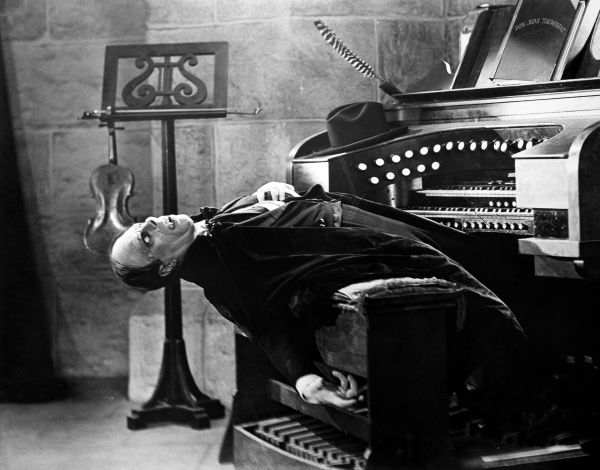
     We started with "The Phantom of the Opera," starring Lon Chaney. Released in 1925, this is a fully silent film, and stands on its own, years before the rest of what Universal would create were released. Based on Gaston Leroux's 1910 novel that would gain superstardom as a stage musical nearly a century later, Universal's take on the Opera Ghost is every candlelit bit a monster movie. Lon Chaney, who famously did his own makeup for the Phantom (some of which involved actual fish parts), did so in secret and revealed his look to many on set for the first time during filming. Universal's publicity about the film was also similarly tight-lipped; hiding the Phantom's look from all promotion and saving his unmasking for the film. 


     This end result, shot almost 100 years ago, is dreamlike and hypnotic for many reasons, the least of which is that this film was made so long ago. These actors donned costumes and performed across great sets, of the Paris theater and the Phantom's underground lair, almost one hundred years ago. The prints that exist of this film are grainy, but we should be thankful they exist at all, as this film was very nearly lost to the obscurity of history. The set pieces herein are gorgeous; whether it's the opera and ballet being performed, or the Phantom's taking of Christine Daae down to his musical lair. The horror is also ramped up; the Phantom's famous unmasking scene is the horror the film hinges on, and the Phantom's terrorizing the opera, its guests and Christine is played up to great camp and creepy effect-- the Phantom at points using an air tube to travel under his underwater lake to Raul's boat, at the end taking Christine into a carriage ride filled with shots of a manic and maskless Phantom at the reins.


     Of note watching the film again, I was struck by how much of the imagery popularly associated with the Phantom of the Opera, especially in Andrew Lloyd Weber's stage musical, appears to have originated in this film. From the caped Phantom atop a statue watching Christine and lover Raul on the rooftop, to the Phantom's dressed Skeleton masquerade costume. These happenings may have been described in the book, but it is interesting that the exact look of them seem not to have changed in popular adaptation in close to 100 years. Unique to this film-- spoilers ahead for the remainder of the next two paragraphs only-- is the ending, which was changed. Originally filmed more faithfully to the original novel, with the Phantom dying at his organ after letting Christine go, test audiences did not respond well, and the striking chase scene through the scenes of Paris-- passing Notre Dame and arriving at the Seine where the Phantom is beaten by the mob and thrown into the river-- was filmed and added to appease audiences. 


    Two things stood out, very starkly, about the ending. One is how brutally and ultimately they deal with killing the Phantom, the horror, at the end; beating him to what appears to be death and throwing him in the river. And second, how even with that finality, while we are not shown a body, the possibility of his surviving and emerging from the Seine to terrorize another day is very present. In what appears to have been an effort to avoid showing the violence of what befalls the Phantom, the door was left open for generations of horror film endings that appear to triumph over the monster (or do they?) only to leave the door open for future sequels. 


     The evolution of the Phantom named Erik's mask is also interesting. In the present day, the most commonly associated mask is that popularized by the Lloyd Weber musical, with the simple white mask covering half of Erik's face. The mask in the Chaney film covers the entire face, and is a simple, almost theatrical likeness of a human face that changes to loose cloth (curtainlike?) under the eyes. The understated nature of this mask, with the antique look is uniquely unsettling. 

Lon Chaney in full makeup


     One doesn't have to go far to see how the success of the this film spurred the next installments in the Universal series, and would forever shape horror in film. With the introduction of sound, the film was reworked and rereleased in 1930 with segments of sound and music. While Chaney was unable to be in reshoots as he was by then under contract with MGM, other actors in the film reprised their roles in the reworked film which was released to great success. This reissued film has sadly and apparently been lost to history, but there are clips online of a home video reworking that put pieces of the soundtrack (the soundtrack, which alone has survived) and it does appear that the Phantom-- even while silent in a talking film-- is even more affective, juxtaposed with the sound and music around him. Grossing over a million dollars in 1930, it's clear that this film and its rereleases proved that there was big business in horror. For the purposes of our Universal Monsters Movie Binge, I have decided to only watch the original films; no sequels, remakes or reimaginings (those will come later.) 


Chaney's Phantom at the masquerade. 


     It is clear, watching this 1925 horror smash hit, why it struck such a note with audiences, and why they wanted more. And why Universal readily gave it to the world, and made history. 


Monday, September 7, 2020

Scary Book Club: "Something in the Blood: The Untold Story of Bram Stoker, the Man Who Wrote Dracula" by David J. Skal


 A number of years ago, I read "Death Makes a Holiday" by David J. Skal. A cultural historian, critic and writer, Skal has made something of a career writing in an academic but immensely readable way about the horror genre, and the holiday and real life people that surround the world of the macabre. I loved and devoured "Death Makes a Holiday," a gripping history of the holiday we now know and celebrate as Halloween, and I always wanted to go back to his writing sooner. I finally did this summer, and I so regret not doing so sooner. 

"Dracula The Definitive Edition" with illustrations by Edward Gorey 


 I have loved "Dracula" since before I read the novel. Horror, the macabre, and scary stories that bump in the night have intrigued me from my earliest memories, and I was always drawn to the blood sucking count from Transylvania. I first read Bram Stoker's 1897 novel in the seventh grade, for a book report assignment in which we had total freedom to read any (approved, though not held to rigorous standards) book. I remember laying in my bed reading through the words and happenings and Jonathan Harker's travels and the Count holding him captive and the vampire brides and the nighttime sea voyages and the graveyard by the sea and Carfax Abbey and Mine and Lucy and Dr. Van Helsing. I knew I was not understanding everything I read, but what I read I loved. Count Dracula has become a cultural legend, eternally living in countless books, films, television programs and beyond, at a level few other fictional characters have. I've always been interested in Bram Stoker, the monster's creator, but knew precious little of his life. I picked up David J. Skal's massive "Something in the Blood" this summer, and instantly fell into its mesmeric, almost vampiric spell. And it is absolutely one of the best biographies I've ever read.

Whitby, North Yorkshire, England; inspiration for "Dracula" 


 This book is many things. A biography of Bram Stoker. A meticulously researched study of the writer's life, giving full social, political and cultural context of his time. And a studied look at how the novel lived on after Stoker's death, and it's journey into stage and screen adaptations-- and beyond. From the early chapters were Skal details the upbringing of his parents and the birth and childhood of Stoker-- as he recounts amaizng histories of plagues and burial practices and the literature young Bram would have had access to and read-- I knew this was something special. 

Bela Lugosi as Dracula in Universal Studio's 1931 film 

     As someone who considered themselves a student of history, who works often in the field of genealogy, I as greatly sympathetic to the historian's dilemma; how to tell history, what is known, by accurately retelling the facts and responsibly presenting informed hypotheses when appropriate, and when details are lacking. This is not an easy task, but it is one that Skal balances beautifully. In this book, we are told the facts of Bram's life; his family, his mother, Florence the woman he would later marry, and a nearly unbelievable cast of characters that include the major artists of his time such as Walt Whitman and Oscar Wilde. Many times of his years, facts are scarce, but Skal presents them, and the possibilities, probabilities and the fact that we often may never know the truth for certain in a masterful way. 

Frances Balcombe, as drawn by Oscar Wilde

 This is very much the case when it comes to Stoker's wife, Florence, and his reported sexuality. Much of the correspondence between Florence and her former suitor, Oscar Wilde, is lost to history, but what remains offers endlessly interesting possibilities about the nature of their relationship. Likewise, when it comes to Stoker's much rumored sexuality, there is a plethora of lines to read between. The letters young Bram writes to Walt Whitman after reading his work, on male love, reads, even with the most conservative of caution to consider the time they were written in, like someone coming out of the closet. One can only wonder what Whitman and Stoker discussed when the met at multiple points during the American tours of the Lyceum theater Stoker; though, of course, we'll never know. 

County Dracula and Jonathan Harker in BBC One and Netflix's "Dracula" (2020)

 We will also never know the true nature of Stoker's decades long friendship with the writer Hall Caine. Many of Stoker's letters to Caine appear to have been lost (perhaps even discarded by Florence), but it begs thought exactly how deep the two men's relationship was (and the man who Stoker famously dedicated "Dracula" to.) This is especially interesting when the homosexual subtext in the novel is examined; the lusting Count Dracula has for Jonathan Harker, and the fear of that forbidden. Gender and sexual variance is a theme explored by Stoker not just in "Dracula," but in numerous others of his fiction works, and the examination of these issues, as well as race and culture, are discussed at length in the book and never fail to be anything but engrossing. 

Hall Caine

 Stoker's novel, as Skal points out at length, has endured because "Dracula" plays out many of humanity's most enduring issues and fears; life and death and triumphing over death, religion, the Other and fears of what is not us; the fear behind romance and seduction. Bram Stoker wrote a novel, well over 100 years ago, that masterfully explores these themes-- all while being a tremendously entertaining, satisfying and frightening read. 

Henry Irving and Bram Stoker

     While much of Stoker's life will likely forever be lost to history, the story of the sickly boy who loved stories, and grew up into athletic intellectual who found himself in the work and friendship of writers like Walt Whitman, appears, the stuff itself of great fiction. Stoker, this man who made a living working his life for actor Henry Irving and his theater (a man who Stoker idolized, but often treated him like little more than a servant beneath his celebrity; a servant who was, in the spare time he had, writing work that make him and his work immortal) lived an uncanny and endlessly interesting life, and Skal's brilliant book is a-- while a commitment-- a must read for any serious fan of "Dracula" and the all the novel and character have spawned in popular culture.  


Bram Stoker
Bram Stoker